The exterior house lighting ideas that changed how our house reads from the street cost under $300 for four fixtures and one weekend afternoon: matte black outdoor wall lamps flanking the front door, unlacquered brass ones at the back porch, 2700K bulbs, and a dusk timer. We'd had the original builder lights on the house for four years, brass, not the warm living brass that's fashionable now but the 1990s polished-gold brass that ages into a color with no polite name, and we'd walked past them without seeing them until I photographed the house for something and looked at it on a phone and thought, oh no. This post is the photo test, the front porch in black and why black, the back porch in brass and why the two don't fight, the mounting and the wiring boxes, the bulbs and the temperature, the dusk timer, the height and the spacing at a door, the garage and the driveway, the path and the steps, what we didn't do and why, the IP rating and the finishes that last a Portland winter, the rental version, the mistakes, what it cost, and why exterior lighting is the most underestimated thing you can do to a house.
The photo test
Take a photo of your house from the street at dusk with the lights on, and look at it on a phone. The eye edits a house it lives in; the phone doesn't. Ours showed two yellowed brass carriage lanterns with cool-white bulbs beside a black front door, one with a cracked glass, and the whole facade looking like a house nobody had made decisions about. It's the test I'd give anyone before spending a dollar on the front of a house, and it's free.
Front porch: matte black
Two matte black outdoor wall lamps flanking the front door, simple cylinders with the light directed down, at 66 inches to center, 8 inches from the door frame. Installation took two hours, because the mounting pattern matched the existing wiring boxes almost exactly and the plates covered the paint line from the old lanterns. Black against the pale grey siding and the black door is graphic and modern, and the difference from the street was immediate and significant: the house went from looking like a house to looking like a house someone had made decisions about. Black is the choice when the door is dark or the trim is white, because it repeats a line that's already there.
Back porch: brass, the new kind
For the back porch, one brass outdoor wall lamp beside the door and one over the steps, in unlacquered brass that develops a patina rather than the sealed kind that stays shiny. Two years in it has a warm, settled look that matches the cedar deck boards better than black would have, and the patina is uneven in a way that reads as age rather than neglect. The front is graphic and modern; the back is warm and relaxed. The two don't fight because they're never seen at the same time, and the rule for mixing exterior finishes is that: one finish per elevation, and the elevations don't have to agree.
Mounting, and the wiring boxes
Exterior wall lights mount to a round or octagonal box in the wall, and the new fixture's plate has to cover the old fixture's footprint or you're patching siding. Measure the old footprint before buying; a plate 6 inches across covers most 1990s lanterns. The box itself: if it's plastic and cracked, replace it while the wall's open, $6. The fixture's gasket goes against the siding, the plate screws to the box, and a bead of exterior caulk across the top edge only, never the bottom, so water that gets in can get out. Breaker off, the old fixture down, the new one wired black to black and white to white with the ground to the green screw, and two hours for two of them with a helper holding the fixture.
The bulbs and the temperature
2700K, and 2400K if the fixture shows the bulb, because a cool bulb outside makes a house look like a gas station from the road and a warm one makes it look occupied. 400 to 500 lumens per fixture at a door, which is plenty at a porch and reads as a glow from the street; the 800-lumen daylight bulbs that were in the old lanterns lit the neighbors. Outdoor-rated LEDs, which tolerate the cold, and a frosted bulb in a closed-top fixture or a filament in a clear one. The old lanterns had been at 5000K for four years, and half the "oh no" in the photo was the color.
The dusk timer
All four fixtures on a smart dimmer inside the door that follows local sunset: on at dusk at 60 percent, off at midnight, on again at 5 am in winter for the school run. The house looks occupied from the street when we're away, nobody ever forgets the porch light, and the front lights are the first thing the house does every evening. It's $48 and it's the part of this project that changed the daily routine rather than the look.
Height and spacing at a door
Center of the fixture at 60 to 72 inches from the porch floor, about a quarter of the way up from the ground on a standard 80-inch door, and 6 to 12 inches from the frame; two fixtures on a wide door, one on the latch side of a narrow one. The fixture height should be about a quarter to a third of the door's height, so a 20-inch fixture on an 80-inch door and not the 8-inch one I nearly bought, which would have looked like a nightlight. Light directed down, so the fascia and the step are lit and the guest's face isn't.
The garage and the driveway
The garage had a motion floodlight over the door that came on for cats and blinded the porch; it's gone, replaced by two matte black fixtures matching the front door's, one each side of the garage door at 72 inches, on the same timer at 40 percent. A garage lit like the front door reads as part of the house; a garage with a floodlight reads as a warehouse. If security is the worry, a motion sensor on the side yard where nobody should be, not on the front where everybody is.
The path and the steps
Two low path lights at 12 volts along the 20-foot walk, alternating, and a small light on each side of the two front steps, all on the same timer through a transformer by the garage. Nothing brighter than the door fixtures, so the eye moves toward the door. The path lights were $60 for four and took an hour to stake and wire; the step lights were the ones that made the front safe in a Portland November, when the steps are wet leaves.
Choosing the fixture: shape, size, and the door
A cylinder or a simple box with the light down for a modern or a mid-century house, which a 1964 ranch is; a lantern only for a house that was built for one, which this wasn't. Size by the door: fixture height a quarter to a third of the door's, so 20 to 26 inches beside an 80-inch door, and smaller, 12 to 16, beside a garage door where the fixtures are a pair on a wide wall. Finish by the elevation: black where the trim is white or the door is dark, brass where the wood shows. And the bulb hidden or shown on purpose: a closed-top cylinder hides it and lights the wall and the step, a clear lantern shows it and needs a filament worth seeing. The brass versus black post is the finish argument for inside, and it holds outside with one addition: brass outside has to be solid or lacquered, or it turns green.
Seeing the house from the street after
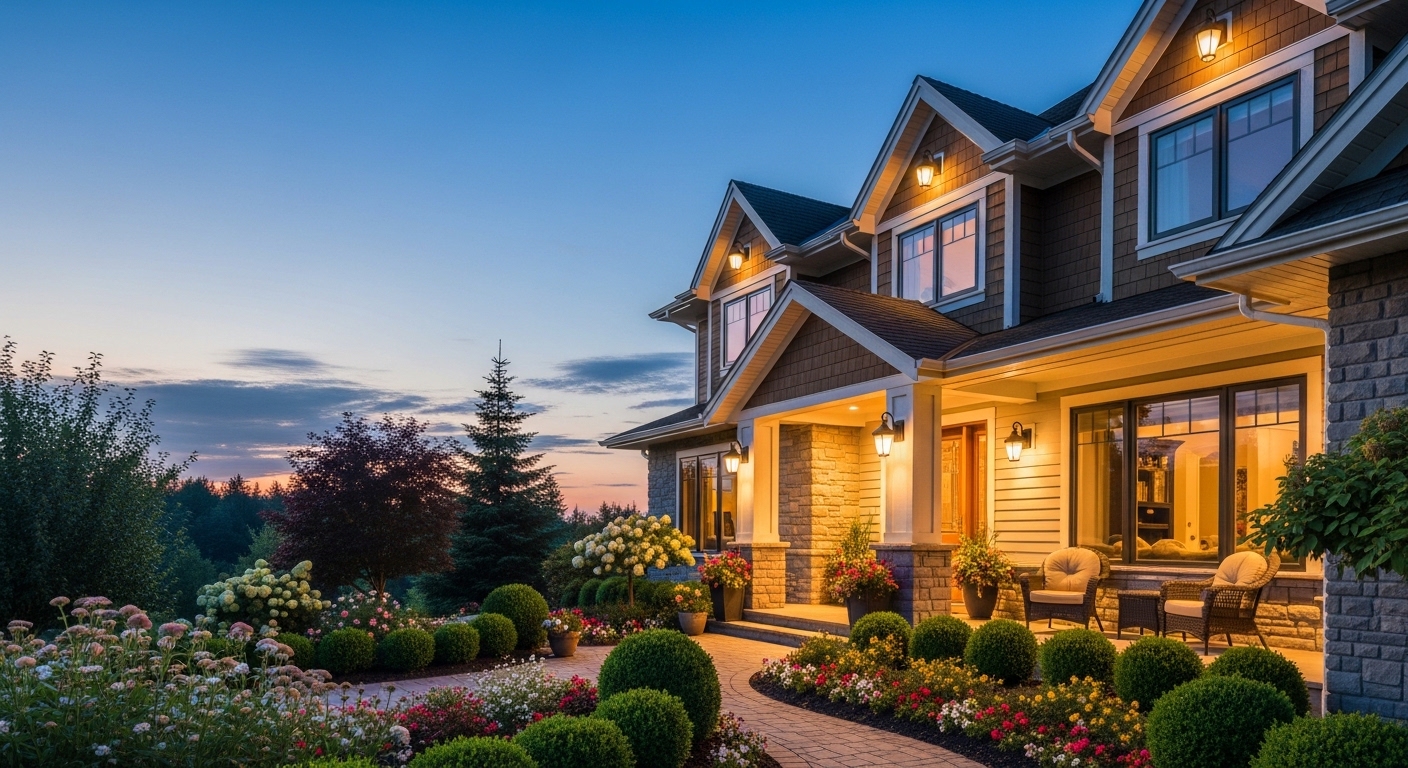
Walk to the curb after dark and look. Two warm points either side of the door, the step lit, the path a line of low lights, the garage a pair of quieter points, and the windows warm behind. If the bulbs are visible from the curb, they're too bright or the fixture is open; if the facade is lit like a monument, there's an uplight to remove. Ours reads from the curb as a house with the lights on, which is the whole goal, and the phone photo now looks like a house I'd stop at.
What we didn't do
Uplights on the facade, which make a ranch look like a bank. Lights in the trees, which are a garden center. A lantern on a post at the drive, which the house doesn't have the length for. Colored bulbs at Christmas, which are for other people. And a carriage lantern of any kind, because the point of the change was to stop the house apologizing for 1994.
IP rating and finishes for a Portland winter
Under a porch roof, a damp-rated fixture is enough; on the garage wall, wet-rated, and the IP number if the box gives one should be 44 under cover and 54 or more exposed. Finishes that survive eight months of rain: powder-coated steel or aluminum, solid brass, copper; finishes that don't: plated anything, painted zinc, cheap aluminum that chalks. The black fixtures are powder-coated and look as they did; the brass ones are solid and are doing what brass does. The 1990s lanterns were plated, which is why they were the color they were.
The rental version
A rechargeable outdoor sconce with a dusk sensor, mounted with outdoor adhesive strips beside the door, and a solar path light or two: about $90, no wiring, no landlord, and it comes with you. The same 2700K rule, the same height, the same downward light. It won't match the fixture on the other side of the door, and a single sconce on the latch side is a fine answer for a rental front door.
Mistakes
Four years of not looking. The 8-inch fixture I nearly bought for an 80-inch door. A 3000K bulb in the black fixtures the first week, which was fine and not warm; 2700K was the house. Caulking the bottom of the plate, which trapped water and was redone. And the motion flood over the garage, kept for a year after the front was done, because "security," until a raccoon set it off at 3 am for the tenth time.
What it cost
Two matte black front fixtures, $140. Two brass back fixtures, $150. Two black garage fixtures, $130. Four path lights, a transformer and two step lights, $160. The smart dimmer, $48. Bulbs, $30. About $660 for the whole exterior over two weekends, and the first $290 and one afternoon, the four door fixtures, was the part that changed the house from the street. Total for the original plan, the four fixtures, was under $300, which is what the post used to say and is still true.
In one paragraph
Photograph the house at dusk on a phone. Replace the door fixtures with a pair sized a quarter of the door's height, in black or brass by elevation, light down, 2700K, on a dusk timer. Match the garage to the front door, add low path and step lights, take the floodlight down, and stop. Under $300 and an afternoon for the part that matters, and the entry formula takes over the moment the door opens.
The most underestimated thing you can do to a house
Exterior lighting is systematically underestimated as a home improvement category, because you don't see it from inside and because the builder's fixtures are "fine." Two hours and $140 at the front door did more for how this house reads than the $16,400 bathroom, and it's the thing neighbors have asked about. Take the photo at dusk. If you say "oh no," it's a weekend and under $300, and the house you come home to will look like one someone chose.
Shop this post: outdoor wall lights in matte black and brass, and rechargeable wall sconces for doors without wiring