Open shelving in a kitchen works about 70 percent of the time, looks like a garage shelf the other 30, and whether it works for you depends on a rule you set before the first shelf goes up: what lives on each shelf, and what never does. Two years ago I removed the upper cabinets on one wall of our kitchen and installed three solid oak shelves, about $400 including the patching, and the kitchen felt dramatically more open the same afternoon. That's the good part, and it's real. The honest part is that open shelves don't hide anything, and a kitchen that had been fine with mismatched mugs behind doors needed a system the day the doors came off. This post is what open shelving does to a kitchen, the 70/30 reality, the three-shelf rule that made it work, what to put on open shelves and what never to, the dust and grease question and how far from the stove, brackets and depth and load, the oak and why one wood, the cost against uppers, the styling that isn't styling, the half-and-half kitchen, the rental version, mistakes and whether I'd do the other wall.
What open shelving does to a kitchen
Upper cabinets are a wall of boxes at eye level, and in a 1964 ranch kitchen with 8-foot ceilings they were the thing that made the room feel like a corridor. Taking one wall of them down opened the room: the wall is visible, the window beside it looks bigger, the counter below feels deeper, and the kitchen reads as a room rather than a work station. It also took away 12 feet of closed storage, which is the trade, and the things that had lived in those cabinets had to go somewhere: the everyday ones onto the shelves, the rest into the pantry and the base cabinets, and about a quarter of them out of the house, which was overdue.
The 70/30 reality
When the shelves are well styled, which is about 70 percent of the time, the kitchen looks like a magazine. The other 30 percent, after a week of real cooking with a nine-year-old in the house, they look like a garage shelf: a cereal box that migrated up, a mug with a spoon in it, the good bowl with a lemon in it. Open shelves don't hide anything, and the honest question before installing them is whether you can live with the 30. I can, because the 70 is worth it and because the system below got the 30 down from where it started, which was about half.
The three-shelf rule
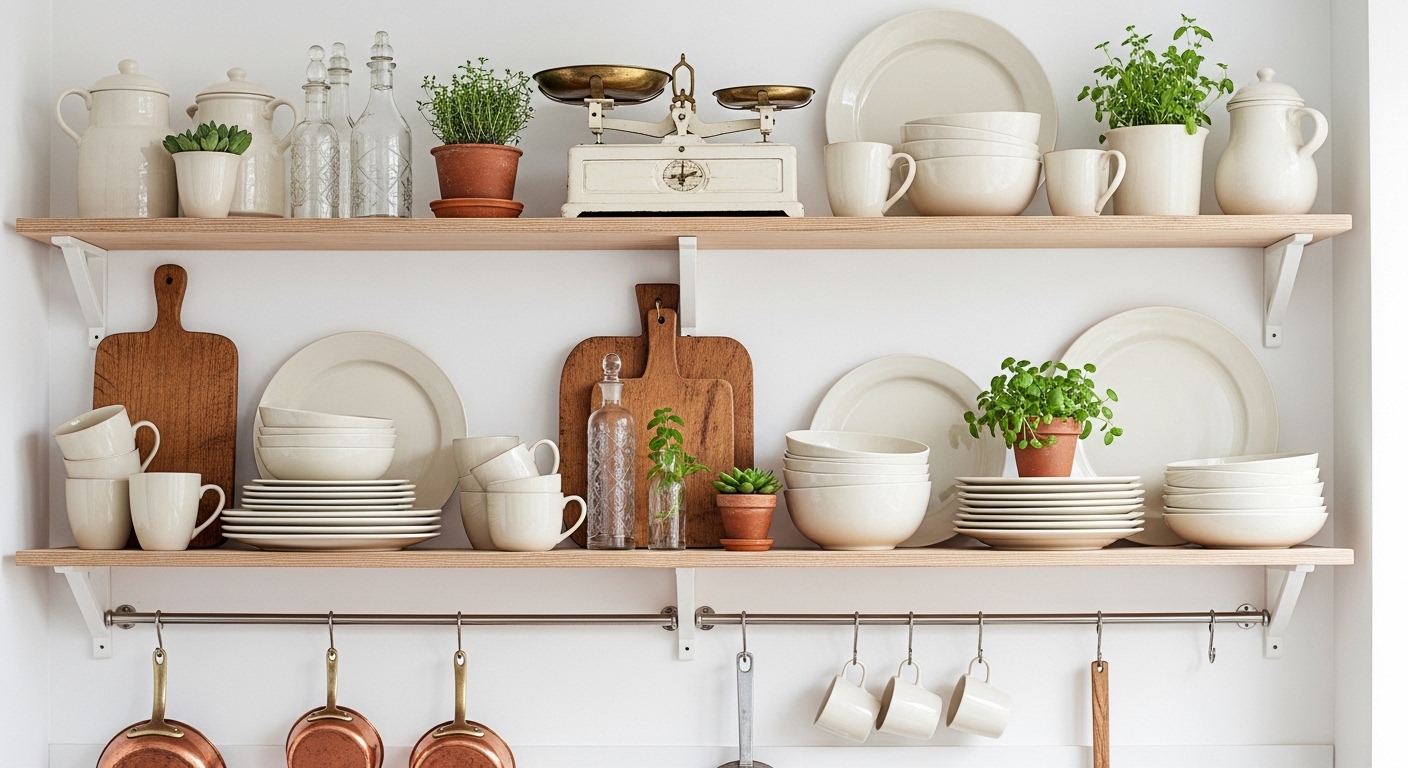
Top shelf, at 72 inches: decorative only, a plant, a bowl, something I never touch, and nothing that comes down daily. Middle shelf, at 60: the daily things, the eight mugs, the everyday plates and bowls, always returned to exactly the same spot, which is the rule that makes the shelf look styled when it's only tidy. Bottom shelf, at 48: the practical layer, cutting boards leaning, bread, the oil, the everyday chaos, and nobody looks at the bottom shelf because it's below eye level and the middle shelf is doing the work. The rule took a month to learn and it's the reason the kitchen is at 70 and not 50. A shelf that holds one category stays tidy; a shelf that holds everything is a cabinet without a door.
What to put on open shelves, and what never to
Yes: the dishes you use every day, in one or two colors, so the repetition reads as order; glasses, in a row; a plant; a wooden board; a bowl of something that gets eaten; one pot that's worth seeing. Never: food in packaging, which is the thing that makes a shelf a pantry; small appliances, which are boxes; the twenty mismatched mugs, which went to the base cabinet with the doors; anything you use once a year; and anything with a label, because a label is a sign that says "storage." The test is whether you'd be happy for a guest to look at it for a minute, because on an open shelf they will.
Dust, grease, and how far from the stove
Open shelves collect dust and, near a stove, grease. Ours are on the wall opposite the range, 9 feet away, and the film is dust that a damp cloth handles monthly. A friend put open shelves beside her range and wipes grease off the top shelf weekly and off the mugs before using them, which is the version of open shelving that sends people back to cabinets. The rule: no open shelf within 4 feet of a cooktop, and if the kitchen is small enough that everything is within 4 feet, open shelves are for the wall with the sink, and a good range hood is part of the budget. Daily-use dishes on the middle shelf don't collect dust, because they're used daily; the top shelf does, and it's dusted on the first of the month.
Brackets, depth, and how much a shelf holds
Shelves 10 inches deep, which holds a dinner plate on its edge with an inch to spare and doesn't stick out into the room; 12 inches is the maximum before the shelf shades the counter. Solid oak, 1.5 inches thick, 60 inches long. Heavy-duty steel brackets into studs, one every 16 inches, rated for far more than the shelf will ever hold, because a shelf of plates weighs 40 pounds and a shelf that sags by an eighth of an inch shows. Floating brackets hidden in the shelf are the cleaner look and need a thicker shelf and a wall you can bolt into; ours are exposed black steel, which reads as intentional and cost $60 for nine. Level matters more than on any other surface in the house, because a row of glasses shows a sixteenth of an inch of slope.
Oak, and why one wood
The shelves are solid white oak with a matte oil finish, chosen to match the butcher block counter and the stools, and one wood is the thing that keeps the wall calm: oak shelves, oak counter, oak stools, and the white cabinets and the brass pendants around them. Wall shelves in one consistent natural wood give enough visual structure that even imperfectly styled, the wall doesn't look chaotic; the wood tone anchors it. I followed it with a matching oak shelf in the adjacent dining area for books and plants, and the two spaces read as one decision. Painted shelves show every chip; pine yellows; the reclaimed-wood look is another costume. Oak, oiled, once a year.
The cost against upper cabinets
Removing three uppers, patching the wall where the cabinets had been, painting, three oak shelves cut to length, nine brackets and a Saturday: about $400. New upper cabinets for the same wall would have been $900 to $1,400 installed, so open shelving saved money as well as space, which is not why I did it but is why my husband agreed. The hidden cost is the base-cabinet reorganization and the pantry that had to absorb what the uppers held, which was free and took a weekend.
Styling that isn't styling
The kitchens in magazines with open shelves are styled by someone for a photograph, and the style doesn't survive breakfast. What survives is repetition and rules: the same eight mugs in a row, the plates in one stack, glasses in a line, and one thing that isn't dishes per shelf. Odd numbers of objects, three not four. Something tall at one end. Nothing pushed to the back, because a shelf is 10 inches deep and the back is where things go to be forgotten. And the discipline of putting the mug back in its spot, which my daughter learned faster than my husband. The minimal month was where the discipline came from, and the shelves are where it shows.
The half-and-half kitchen
Open shelves on one wall and closed cabinets on the rest is the version that works for most people and for us: the wall by the window is open and holds the daily dishes, the wall by the range is closed and holds everything else, and the pantry holds the food. All-open kitchens are for people who own twelve of everything in white and no cereal; all-closed kitchens are the corridor we had. One wall open is the sweet spot, and it should be the wall you see from the door and the wall furthest from the stove, which in our kitchen are the same wall.
The rental version
You can't remove a landlord's cabinets, but you can take the doors off one bank of uppers, store them in the closet, and put the daily dishes in the open boxes with the rule applied; it's open shelving without a patch, and the doors go back on when you leave. Or a single oak shelf on brackets on an empty wall, two screw holes per bracket, for the mugs and the plant. The thrift store post is where the mugs and the bowls came from, which is the other half of why the shelves look like a decision.
Lighting the shelves
An open shelf wall is a wall you look at, and it's dark under a shelf. A stick-on LED strip under the middle shelf, 2700K, on a switch, lights the counter below and the plates above it from below, and turns the wall into the kitchen's warm spot in the evening with the pendants at 40 and the strips off. Under-cabinet lighting was the thing I lost when the uppers came down, and the strip under the shelf gave it back; the under-cabinet post is the honest version of that. No sconce on the shelf wall itself, because the shelves are the sconce's wall and the two argue.
What the base cabinets and the pantry had to absorb
Three uppers held about 12 cubic feet, and the shelves hold about 4 of daily things, so 8 cubic feet had to go elsewhere: a base cabinet was reorganized with a two-tier pull-out for the mugs that didn't make the shelf; the pantry took the food that had been in the upper by the fridge; the small appliances went to the pantry's bottom shelf; and a box of things we'd not used in a year went to the thrift store. The shelves look like a decision partly because the doors elsewhere got fuller, and a kitchen with open shelves and no pantry is a kitchen where the shelves hold the cereal.
Mistakes
The first month with no rule, when the shelves held everything and looked like a cabinet with the door missing. A shelf at 14 inches deep, replaced, because it shaded the counter. The twenty mugs, until they went to a cabinet. A box of crackers on the middle shelf for a week, which is when the "no packaging" rule was written on the inside of a cabinet door. And brackets 24 inches apart, which sagged; the middle bracket went in the second week.
In one paragraph
One wall open, the one you see from the door and the one furthest from the stove; 10-inch oak shelves on steel brackets into studs; a rule per shelf; daily dishes in one or two colors; no packaging, no appliances, no labels; a strip under the middle shelf. $400, and the 70 percent is worth the 30.
Would I do the other wall?
No. One open wall is the right amount for a kitchen where people cook, and the closed wall by the range is where the grease and the ugly things live. The open wall is the kitchen's face and it's the thing people comment on, at 70 percent, and at 30 percent it's a shelf with a cereal box on it, and I've made peace with that. Open shelving is a rule you keep, not a look you buy, and the $400 was the cheapest part.
Shop this post: kitchen pendant lighting for the counter under the shelves and wall sconces for the shelf wall