The bathroom storage ideas that survived a year in our 5 by 8 main bathroom are three: a cabinet over the toilet for the backups, a corner cabinet for the daily stuff, and a recessed medicine cabinet for everything with a label on it, with matching hardware so the room reads as designed rather than assembled. Everything else I tried, the rolling cart, the basket on the floor, the over-door hooks that made the door not close, went to the garage. Our bathroom had one medicine cabinet, one shallow vanity drawer and one cabinet under the sink, and for eighteen months in this 1964 ranch that was fine. Then we had a child, and a bathroom that had held two adults' things found itself holding bath toys, a step stool, two kinds of toothpaste and a hair dryer that lived on the toilet tank. This post is what worked and where each thing went, the over-toilet cabinet and how to mount it, the corner cabinet, the medicine cabinet, under the sink, the vanity drawer, the shower, the towels, the hardware rule, the small-bathroom ideas I'd skip, what it all cost, and the Tuesday-morning test that decides whether storage is real.
The Tuesday-morning test
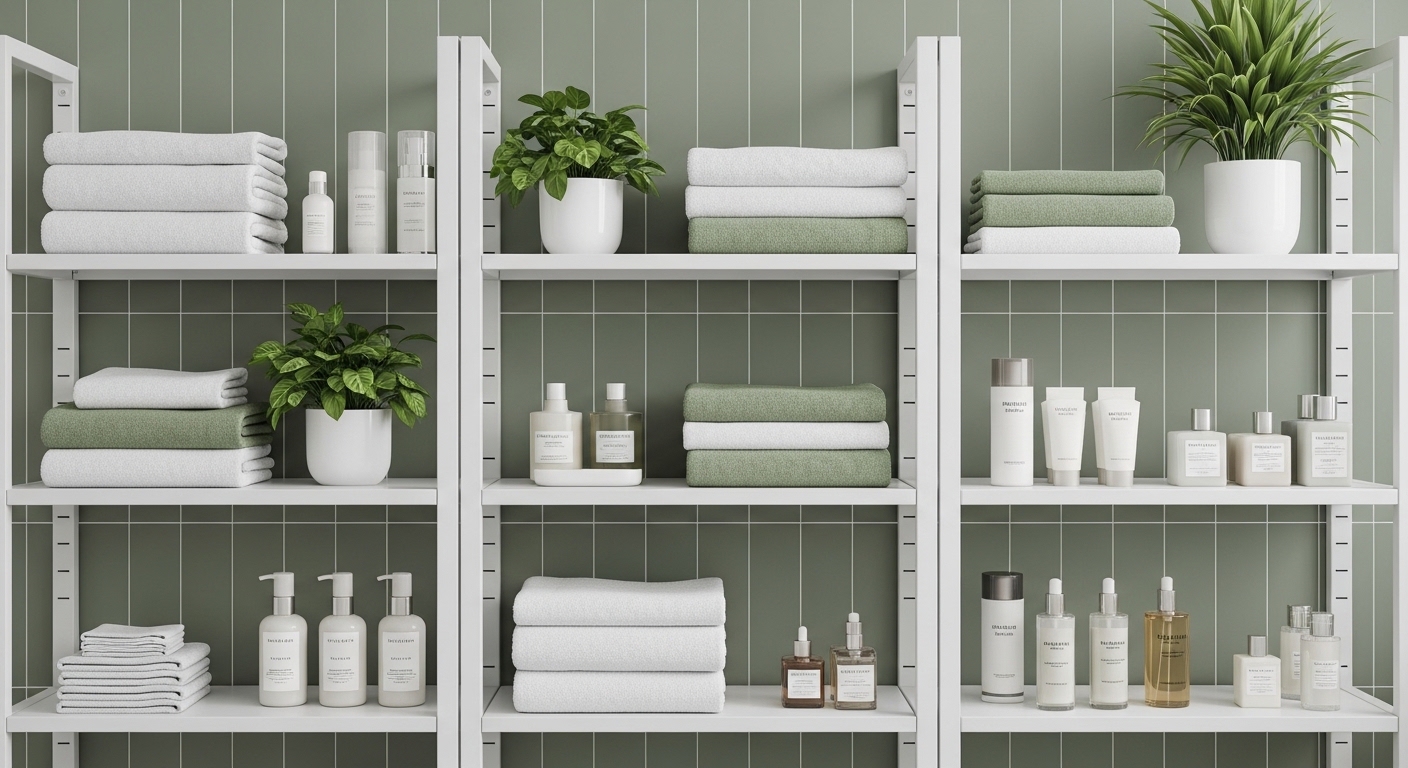
Bathroom storage that looks good in a photo and is a mess by Wednesday isn't storage; it's staging. The test I use now is whether the room looks fine at 7 am on a Tuesday with a nine-year-old brushing her teeth and nobody having tidied since Sunday. Closed storage passes that test and open storage doesn't, in a bathroom, because a bathroom's objects are mostly bottles with labels. That's the whole principle behind the three cabinets: put the things with packaging behind doors, leave the counter with a soap dish and a plant, and let the hardware do the decorating.
The cabinet over the toilet
The space above the toilet tank is the most wasted 30 inches in most bathrooms, and a wall-mounted cabinet there, 24 inches wide, 8 inches deep, two doors, holds the backups: extra toilet paper, spare soap, the medicine we don't use daily, the guest towels. It replaced a freestanding over-toilet unit with legs that straddled the tank and shook every time the lid came down. Mounting: the bottom of the cabinet at least 8 inches above the tank lid so the lid opens, which on our tank is 40 inches from the floor; into studs with two 3-inch screws through the cabinet's back rail, and a French cleat if the studs don't line up, which they didn't in a 1964 wall. A cabinet with doors, not shelves, because the things up there are the ugly things. Ours is white shaker to match the vanity, $140, and it holds what used to live in the hall closet.
The corner cabinet for the daily things
A second cabinet in the corner by the door, 15 inches wide and 60 tall, handles the things used every day: the hair dryer on a hook inside the door, the kids' bath products on the bottom shelf where she can reach them, my things on the middle, my husband's on the top. Before this cabinet those things were on every horizontal surface in the room, because daily-use things need a home within arm's reach or they don't go home. A tall narrow cabinet uses a corner that held nothing, and the door hides the hair dryer cord, which is the single most visible mess in a bathroom. $180, secured to the wall with an anti-tip strap because there's a child in the house.
The recessed medicine cabinet
The medicine cabinet is where everything with a label lives: toothpaste, razors, the daily medicine, the contact lens things. Recessed into the wall between the studs, 16 inches wide, with a thin matte black frame that matches the faucet and a mirror on both sides of the door so you can see the back of your head. The full comparison with open shelves is in the medicine cabinet post; the short version is that open shelves looked better in photos and worse on a Tuesday, and the cabinet closed the storage loop in a way shelves never could. If the wall has no cavity, a surface-mount one with a frame is fine; it sticks out 4 inches and looks intentional if the frame matches the hardware.
Under the sink, which is the black hole
The cabinet under a vanity is deep, dark, and has a drain trap in the middle of it, and most people fill it with a heap. Two pull-out bins on the floor of it, one each side of the trap, one for cleaning supplies and one for extra bottles, and a tension rod across the front to hang spray bottles by their triggers. That's it; three things and the cabinet went from a place we avoided to a place with a system. A vanity with drawers instead of doors solves this better, which is one of the vanity mistakes I'd avoid next time, but the bins fix the vanity you have for $30.
The one shallow drawer
A bamboo divider tray, cut to fit, and the drawer holds the things that are used at the mirror: the brush, the tweezers, the small things that used to roll around. Drawer dividers are the cheapest storage idea in this post and the one with the highest return, because a divided drawer stays organized by itself and an undivided one becomes a junk drawer in a month.
The shower
A corner shelf unit that tensions floor-to-ceiling, four shelves, because the shower had one soap dish and three people's bottles. Rustproof, which means aluminum or coated steel and not the chrome one I bought first, which rusted at the welds in six months. The bath toys live in a mesh bag on a suction hook that drains, and get emptied on Sundays. Nothing on the floor of the shower, which is the rule that makes cleaning take three minutes.
Towels, and the hooks-not-bars rule
Towel bars look tidy and hold one towel each; hooks hold a towel per person and towels dry on them. Three hooks at 65 inches on the wall by the shower, one per person, and a bar on the back of the door for the bath mat. A folded stack of clean towels in the over-toilet cabinet, not on an open shelf, because a stack of towels on an open shelf is a stack of towels until someone takes one and then it's a pile. The robe hook on the door is the one hook that gets used more than I expected.
The hardware rule
The bathroom accessories were the last piece and the one that made it look finished: a consistent set of towel hooks, toilet paper holder, robe hook and a small shelf, all in the same brushed nickel, matching the faucet. Mismatched hardware reads as a rental; matching hardware reads as a designed space, and the room didn't change but it suddenly looked intentional. The bathroom accessories came as a set, which is the easy way to get it right, and the matte black medicine cabinet frame matches the matte black faucet in the other bathroom, not this one, which is a mistake I've made peace with.
Kids' things, which are half the problem
A child adds a category of bathroom object that has no adult equivalent: bath toys, a step stool, a rinse cup, a second toothpaste, a comb that is only hers. The rule that worked: her things live at her height. The bottom shelf of the corner cabinet, the mesh bag at the low suction hook, the step stool that folds and hangs on a hook on the side of the vanity, and her toothbrush in a cup on the counter, which is the one exception to the empty-counter rule because a nine-year-old doesn't open cabinets to brush her teeth. When she's taller the shelf moves up. When the toys are gone the bag goes. The storage grows with her, which is cheaper than redoing it at every age.
Lighting the storage, since a dark cabinet is a junk drawer
A cabinet you can't see into is a cabinet you dump things in. A stick-on LED strip with a motion sensor inside the corner cabinet, on the underside of the top shelf, and a small puck light inside the medicine cabinet, both at 3000K, both $15, and every shelf is visible at 6:30 am with the room lights low. The sconces beside the mirror do the face; the little lights do the cabinets; and the two together are why the medicine cabinet stays organized in a way the open shelves never did. The full lighting fix, sconces at the sides of the mirror instead of a bar above it, is the bathroom lighting post, and it's the other half of why the room reads as designed.
The order to do it in
Clear the counter and the tank first, into a box, and live a week with the box in the hall to see what comes out of it daily; that list is what the corner cabinet holds. Then the over-toilet cabinet, because it's the biggest gain for the least money and the space was doing nothing. Then the hooks. Then under the sink. Then the medicine cabinet, which is the Saturday job. Then the hardware set, last, once the cabinets have shown you what finish the room wants. We did it over six weeks and the counter was clear after the first one.
Small bathroom storage ideas I'd skip
The rolling cart, which is a pile on wheels. Baskets on the floor, which are where the wet towel goes. Over-the-door organizers with pockets, which stop the door closing and show every bottle. Floating shelves above the toilet, which are the over-toilet cabinet without the doors and look like a pharmacy. A ladder shelf, which holds three towels and a plant and takes floor space a small bathroom doesn't have. And anything that stores things on the counter, however pretty the tray: the counter is for the soap and the plant.
Mounting anything in a 1964 bathroom wall
The walls in this ranch are plaster over gypsum lath with studs where the builder felt like putting them, and a stud finder lies. For the over-toilet cabinet I found the studs with a small nail through the paint where the cabinet would hide the holes, marked them, and hung the cabinet on a French cleat screwed into two studs 19 inches apart, which is not 16. For the corner cabinet, toggle bolts rated for 50 pounds each where there was no stud, plus the anti-tip strap into one. For the medicine cabinet, the stud bay turned out to have a vent pipe in it, and the cabinet moved 6 inches left. Measure, then nail-test, then buy the cabinet, in that order; I did it the other way on the first bathroom.
What it cost
The over-toilet cabinet, $140. The corner cabinet and its anti-tip strap, $190. The recessed medicine cabinet, $210, plus a Saturday to cut the drywall and frame the opening. Under-sink bins and the tension rod, $30. The drawer divider, $14. The shower shelf, $38. Hooks and the accessories set, $95. About $720 for a bathroom that had been a heap for eighteen months, and the cabinets were the part that did the work. The vanity, the mirror and the lighting are in the renovation post, which cost a great deal more.
The bathroom now, on a Tuesday
Counter: soap dish, plant. Toilet tank: nothing. Floor: a bath mat. Every bottle behind a door, every towel on a hook, the hair dryer in a cabinet with its cord, the bath toys in a bag. A nine-year-old brushing her teeth and the room looking fine, which it never did with the same square footage and a different set of decisions. Storage in a small bathroom isn't about more of it; it's about doors, and hardware that matches.
Shop this post: bathroom accessories and bathroom sconces