The way to choose art for your home when you know nothing about art is to spend two weeks saving images you keep looking at, buy the piece you can't stop thinking about at a price you won't resent, and hang it with its center at 57 to 60 inches from the floor. That's the method, and the only qualification it requires is the one I had when I bought my first piece as an adult at a Portland street fair for $45: a small oil painting of a lighthouse I couldn't stop looking at. It's still on the bedroom wall, twelve years and three houses later. I didn't know anything about art. I knew I wanted to keep looking at it. This post is the process I've used since to fill a 1,400-square-foot ranch with things we like without a consultant, a budget spreadsheet or a single regret, including where to buy, how much to spend, sizing to the wall, framing, the hanging rules, and the lighting that makes a $45 painting look like it cost more.
Build a reference before you spend anything
Two weeks, one folder, no purchases. Save every image of art you respond to, from anywhere: museum sites, other people's houses, hotel lobbies, a magazine in a waiting room. At the end, look at what you saved and find the patterns. Mine, when I did this properly in year two of the house, were obvious once they were in one place: muted color, a lot of water, landscapes with almost nothing in them, and no people. I'd have told you I liked "modern abstract" if you'd asked me. The folder said otherwise. That's the value: it gives you a clearer picture of your own taste than any afternoon in a gallery will, because you're not being sold anything while you build it. Once you know the pattern you can shop for it, and you'll stop buying things that looked good in the store and wrong at home.
How much to spend on art
Less than the sofa and more than the cushions is the range I'd give, and within it, spend on the pieces you'll see most and least on the ones you'll see least. In our house that means the living room and the bedroom got the real money, a $600 original over the sofa and the lighthouse, and the hallway got $20 thrift-store prints in $30 frames. Prices for what you'll find: original work by a local artist at a fair or a small gallery, $150 to $1,500 for something under 30 inches; limited-edition prints, $80 to $400; open-edition prints from an independent artist online, $25 to $120; vintage prints and paintings secondhand, $5 to $200 and the best value per square inch anywhere; ready-to-hang canvas art, $60 to $250. I keep a rule that no piece costs more than a month's grocery bill, which is arbitrary and has never once stopped me buying something I still wanted a week later.
Where to look, in order of how much you'll like what you find
Local art fairs and open studios first, because the work has a story and the person who made it is standing next to it; every original in our house came from one. Secondhand shops, estate sales and the vintage listings for prints, paintings and the occasional wonderful frame with something dull in it that you'll replace. Independent artists online, where a search for the subject you found in your folder ("quiet lake painting," "minimal coastal print") turns up people making exactly that. Print-on-demand sites with a hand-picked roster, for a large piece at a manageable price. And ready-to-hang canvas art, like the canvas collection we used for the guest room, for a piece that needs to fill a wall this month in a Scandinavian-minimal sensibility that fits most modern interiors. What I'd skip: the big-box "wall decor" aisle, where everything is designed to offend nobody and succeeds, and the sets of three abstract canvases that come in a box, which are the art equivalent of a stock photo.
Size the art to the wall, not to the budget
The most common mistake after hanging too high is buying too small, which is the same mistake people make with rugs and for the same reason: the smaller thing looks reasonable in the store. A piece over a sofa should be 60 to 75 percent of the sofa's width, so a 78-inch sofa takes a piece 48 to 58 inches wide, or a group that spans that. Over a bed, 50 to 75 percent of the headboard width. On an open wall, about two-thirds of the wall's width. If the piece you love is small, group it: three small pieces in matching frames with 2 to 3 inches between them read as one piece the size of the group. The lighthouse is 11 by 14 inches and lives in a group of three on the bedroom wall, which is how a $45 painting holds a wall next to a queen bed.
Framing: where the money makes the most difference
A $20 print in a good frame with a mat looks like a $200 print; a $200 print in a plastic frame from the drugstore looks like a $20 one. Custom framing is expensive, $150 to $400 for a medium piece, and worth it for anything original or anything you'll keep; standard-size frames in wood, with a mat cut to size ($15 online), get 80 percent of the way for a third of the price. Rules I've settled on: the frame matches the room's wood or metal, not the art; the mat is white or off-white and at least 2 inches; glass over prints and paper, none over canvas; and the frames in a group match each other exactly. Six frames in our house are the same $34 oak frame in three sizes, and the consistency does more for the rooms than the art in them.
The hanging rule: center at 57 to 60 inches
The center of the artwork, not the top and not the hook, at 57 to 60 inches from the floor. Always. This is the museum standard and it works in every room with a normal ceiling because it puts the middle of the picture at the average adult's eye level. The most common mistake is hanging art too high, at door-header height, which disconnects the piece from human scale and from the furniture under it. When in doubt, hang lower than your instinct tells you. Over a sofa or a headboard, the bottom edge of the frame sits 6 to 10 inches above the back of the furniture, and if that conflicts with the 57-inch rule, the furniture wins. For a group, the center of the whole group is at 57 to 60, not the center of each piece. I use painter's tape cut to the frame's size for a day before I put a nail in, the same method as in my sconce placement post, and it has saved more holes than I'd like to count. Hardware: a picture hook rated for twice the frame's weight, two hooks for anything over 24 inches wide so it hangs level and stays there, and a small felt pad on the bottom corners so the frame doesn't tap the wall every time the door closes.
Light it, because unlit art is wallpaper
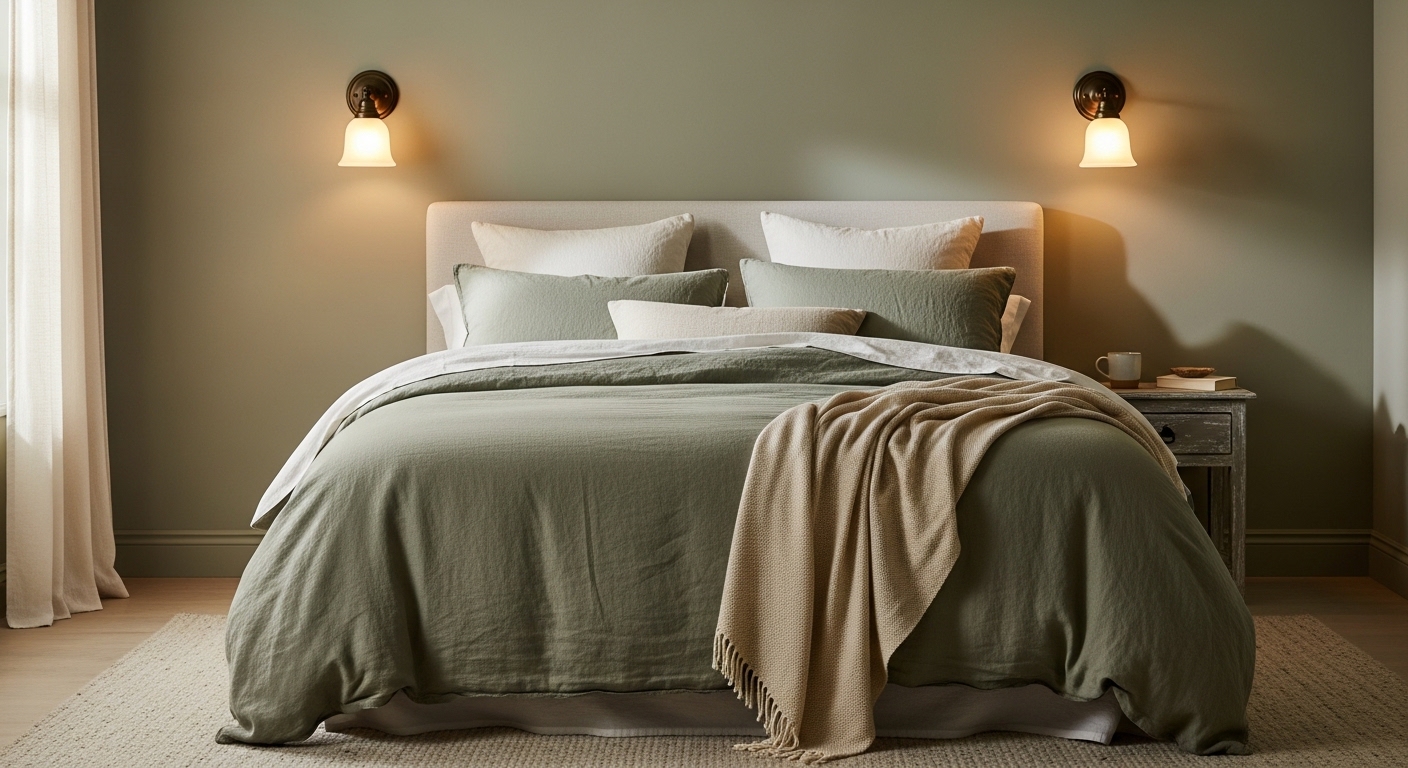
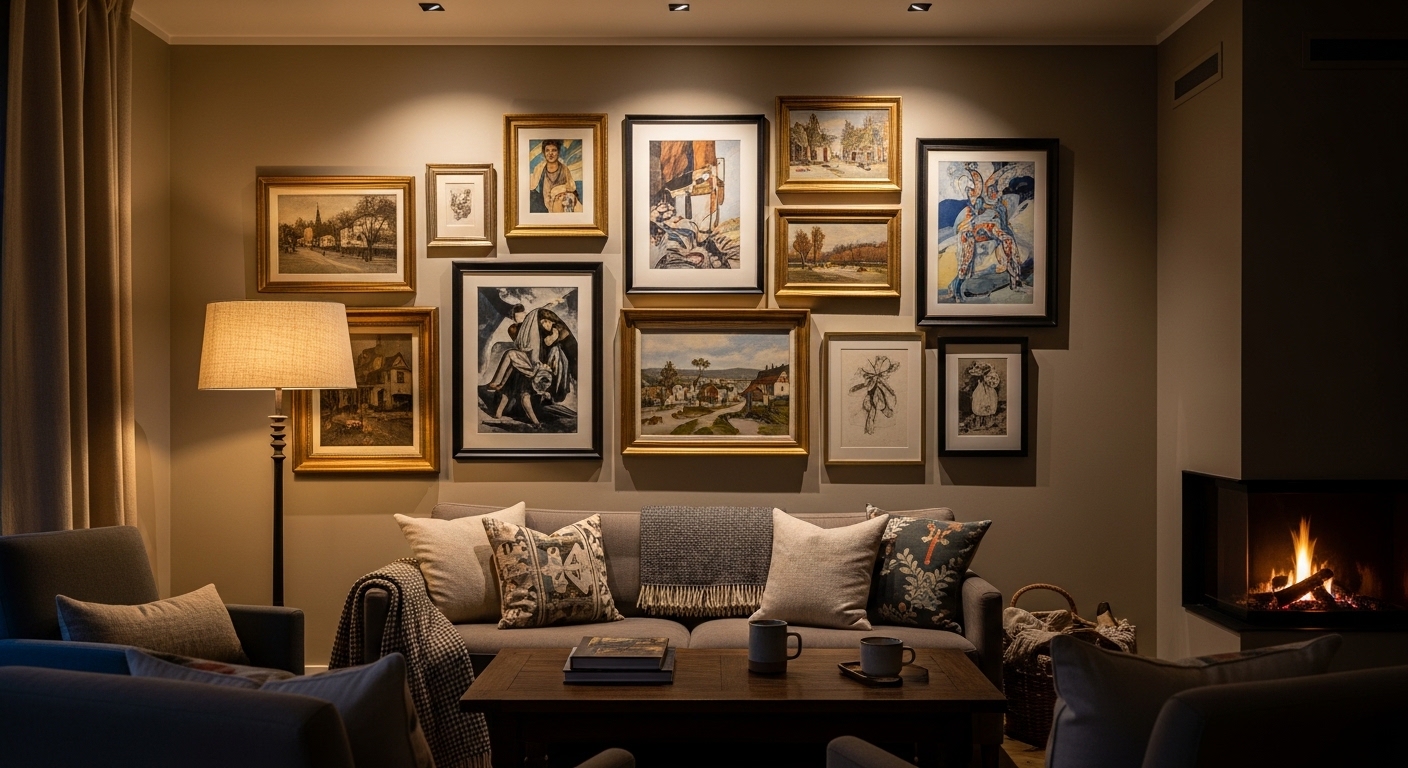
This is the part nobody mentions in art guides and the part I care most about. A painting under a ceiling light is flat; the same painting with light raking across it from the side, or falling on it from a wall light above, has texture and depth and looks like it cost more. Options in ascending cost: a plug-in wall sconce beside or above the piece at 60 to 66 inches, an actual picture light on the frame or the wall above it, or a directional bulb in a nearby lamp aimed at the art. Ours over the sofa is lit by the two sconces that flank it, which are there for the room and happen to fall on the painting too; the lighthouse is lit by the bedside sconce, at 27 inches above the mattress, which lights the bottom of the frame at an angle that makes the water look wet. 2700K, always, and dimmable, because art at 30 percent at night is the last thing you see in the room and the reason to have bought it.
Gallery walls, and when not to
A gallery wall works on a large blank wall with a single strong anchor piece and a rule: frames in one finish, mats in one color, gaps of exactly 2 to 3 inches, and the outer edges of the group forming a clean rectangle or a clean line. Lay the whole thing out on the floor first, photograph it, then transfer it to the wall with paper templates taped up for a day. Where it doesn't work: small walls, walls with a door in them, and any wall where you're using a gallery to avoid choosing one thing. Our hallway is a straight row of five identical frames at the same height, which is the gallery wall for people who like project plans, and it's the arrangement I'd recommend to anyone who isn't sure. The salon-style cluster is for people who have twenty pieces they love and a wall the size of a garage door.
Art in rooms with a specific job
Bathroom: something on paper behind glass, small, hung away from the shower, and lit by the vanity sconces; ours is a vintage map of the Oregon coast. Kitchen: one piece, near the coffee or the table, not over the range, where grease wins. Bedroom: calm, and this is the one room where the folder's pattern matters most, because you look at it last at night; the lighthouse. Entry: one piece you'll be pleased to see every day, at 57 inches, beside the entry sconce so it's lit when you come in. Kids' rooms: their own work, in real frames, rotated, which teaches them more about choosing art than anything I could buy. Hallways: the row. Above the toilet: nothing, because everyone's been in that bathroom.
Mistakes I made, in order
Buying "a piece for the wall" rather than a piece I liked: it lasted a year, and it's in the garage. Hanging everything at the height of the door frames for the first two years in the house, which I only noticed when a friend who works in a gallery walked in and quietly said "hmm." Matching the art to the sofa, which meant the sofa change orphaned the art. Buying a large abstract online in colors that were nothing like the listing, which is why I now order a sample print or check the artist's photos of the piece in a room. And not lighting anything until year four, when the sconces went up for other reasons and the paintings suddenly looked like paintings.
A room-by-room list of what we hung and what it cost
Living room: one 52-inch original oil over the 78-inch sofa, $600 at an open studio, custom framed, $280, lit by the flanking sconces. Bedroom: the lighthouse and two small vintage watercolors in matching $34 frames, about $110 total. Hallway: five thrift prints in the same frame, $160 total, lit by a plug-in sconce at 64 inches. Kitchen: one framed vintage seed-catalog page, $18, over the coffee station. Guest room: a single large canvas, $180, ready to hang. Our daughter's room: her own work in the $34 frames, rotated monthly, $68 in frames, the only art in the house she thinks is any good. About $1,400 across the house over six years, or less than the sofa, which was the rule. The lighthouse, at $45, is still the piece people ask about, and it's still the one I'd grab on the way out.
Shop this post: canvas wall art and wall sconces to light it