When I asked this question on Instagram last winter, 80% of responses said ceiling lights. When I followed up asking which they actually used more at night, 80% said the sconces. That gap tells you almost everything you need to know about how we think about bedroom lighting versus how we actually live in it.
I redesigned our master bedroom last spring. The whole thing, from the paint color (Benjamin Moore Chantilly Lace on the walls, which photographs beautifully and holds a warm tone in the evening) to the hardware to the lighting. I agonized over the lighting more than anything else. I had a flush-mount ceiling fixture that worked fine. I kept asking myself whether that was enough, whether I needed sconces, whether I was solving a problem I didn't actually have.
The short answer: I removed the ceiling light entirely during the remodel. Then I panicked. Then I realized I hadn't turned it on in three years anyway. Our bedroom now has a simple dimmable ceiling fixture (back in, because I came to my senses) and two wall sconces flanking the bed. The sconces are what I use every single evening. The ceiling light is what I use when I'm cleaning or doing laundry in the bedroom, maybe twice a week.
What Ceiling Lights Actually Do in a Bedroom
A ceiling light in a bedroom is a utility fixture. That's not a dismissal, utility matters. When you're getting dressed in the morning, when you need to find something at the back of the closet, when you're doing a full clean of the room, you want overhead light that covers the whole space evenly. A single ceiling fixture at the center of the room does that job well.
What it doesn't do well: it doesn't create the relaxed, winding-down atmosphere that most of us want in the bedroom at night. Overhead light from directly above reads as active and awake. It's the same light you use in an office or a kitchen. Using it in a bedroom at 10 p.m. works against the biological cue you want to send your brain. That the day is done, the pace is slowing, sleep is coming.
This is well-documented in sleep research. The Sleep Foundation's guidance on light and sleep recommends dimming overhead lights and switching to lower, warmer sources in the hour before bed. Sconces positioned at bed height, with warm bulbs (I use 2700K in all our bedroom fixtures), do exactly that. A ceiling light on a dimmer is a reasonable partial solution, but it still casts light downward and outward in a way that floods the room evenly, which is the opposite of the focused, low pool of light a bedside sconce creates.
The Case for Bedside Wall Sconces, My Actual Decision
I chose sconces over table lamps for a few reasons. The first and most practical: our nightstands are small. We have matching IKEA HEMNES nightstands, 18 inches wide, and between a book, a glass of water, and a phone, there's not much surface left. A table lamp base takes up a footprint I don't have. A wall sconce frees every inch of that surface.
The second reason: adjustability. I read a lot in bed. My husband does not. He is asleep by 9:30 and I'm often reading until 11. A bedside sconce with a swing arm lets me direct the light at my book without washing the whole room in light. He can sleep; I can read. This was life-changing and I am not being dramatic about that.
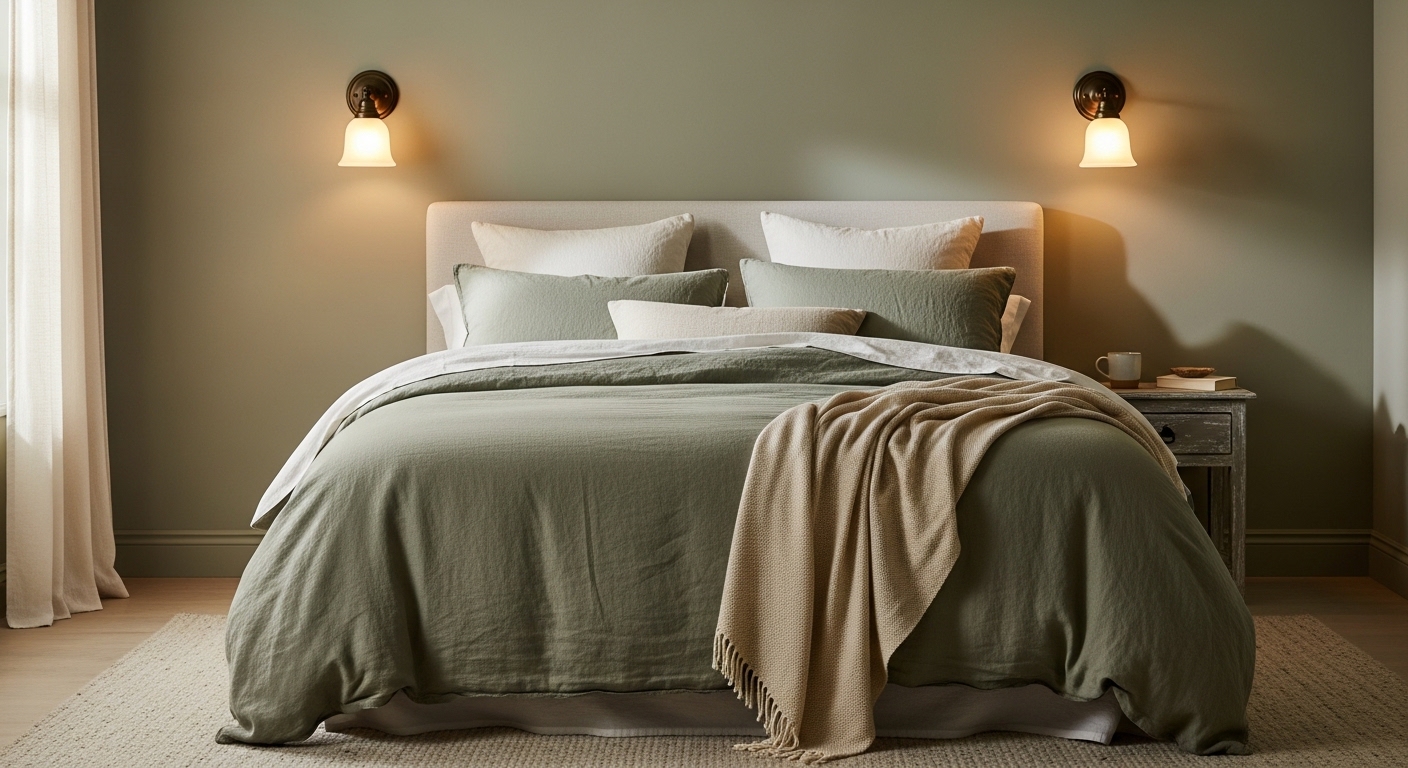
The third reason is aesthetic. Wall sconces flanking a bed create a visual anchor that table lamps simply don't. The symmetry of two sconces, same height, same finish, framing the headboard, gives the bed a finished, intentional look that I find much more satisfying than two table lamps that are inevitably slightly mismatched in height or angle.
I landed on the Hanna glass sconce from BO-HA. The frosted glass diffuses the light so there's no harsh glare point, which matters when you're looking slightly upward from a pillow. The brass hardware reads as warm in our room's color palette. We have warm white walls, a linen duvet in cream, and a bed frame in natural oak. The brass doesn't compete; it completes.
The Right Height for Bedroom Wall Sconces
Height matters more than most people realize, and it's the thing I almost got wrong. My first instinct was to hang them at standard picture-rail height, about 60 inches from the floor, because that's where wall fixtures often end up by default. That's too high for bedside sconces. At 60 inches, the light shines into your eyes when you're sitting up reading. You get glare before you get light.
The formula that works: mount the center of the fixture 58 to 65 inches from the floor, but confirm this against your specific bed. What you're targeting is having the center of the fixture land approximately 24 to 30 inches above the top of your mattress. Our bed with the mattress is 28 inches high, so the sweet spot for sconce center was 52 to 58 inches. I went with 58 inches. I like the light slightly above mattress-plus-pillow height so it can be directed downward toward the page.
I put a painter's tape mark on the wall at 58 inches and sat on the bed, propped against pillows, in my actual reading position. The tape was at about forehead height. Perfect. It's where you want the light to come from at that angle. My electrician, Tom (he's done three projects in our house now), drilled the junction box at exactly that height and the result is exactly right.
The 30% Rule for Layered Bedroom Lighting
Interior lighting designers talk about the 30% rule for layered rooms: no single light source should provide more than about 30% of the total light in a room when all layers are on. This prevents the flat, institutional feel you get when one overhead fixture does all the work. For a bedroom, the layers look like this:
- Ambient: ceiling fixture or recessed lights. The general fill layer
- Task: bedside sconces, directional reading light at bed height
- Accent: a small lamp on a dresser, LED strip behind a headboard, or even a candle. The low, warm atmosphere layer
In practice, this means each layer should be dimmable and you should use them at different intensities at different times. In our bedroom: during the day or early evening when we're getting ready, all three layers might be on, ceiling at 60%, sconces at 40%, dresser lamp at 40%. By 10 p.m. reading time, it's sconces at 70%, dresser lamp at 20%, ceiling off. That combination creates a room that feels noticeably different from daytime mode. It feels like evening. The transition matters.
I also use this layering logic in our living room, worth reading more about in my post on how I think about layered lighting through the whole house. The principles are the same; the proportions shift based on room function.
Cost Comparison: Sconces vs Ceiling Lights
Here's what I actually spent on the bedroom lighting overhaul:
| Item | Cost |
|---|---|
| 2 × Hanna glass sconces (BO-HA) | $218 |
| Replacement ceiling fixture (simple flush mount) | $64 |
| Electrician labor (Tom, 3 hours) | $195 |
| 4 × warm white E26 LED bulbs (2700K) | $28 |
| Total | $505 |
The electrician cost is the one that surprises people who haven't done hardwired sconces before. If your wall has no existing junction box at the sconce location, which ours didn't. The electrician has to run wire from the ceiling or a nearby box. Tom ran wire from the ceiling fixture box down through the wall to two new junction boxes on either side of the headboard wall. It took about two and a half hours plus patching time. If you have a plaster wall like we do, add drywall patching and repainting to the cost, another $80 in materials for me since I painted it myself.
Alternatively, if you don't want to hire an electrician at all, plug-in sconces are a legitimate option. Plug-in wall sconces give you the look without the wiring cost. The cord runs down the wall and plugs into a standard outlet. You can hide the cord with a cord cover painted to match the wall. It's not perfectly invisible, but at bed height behind the nightstand it's rarely noticeable. For renters or anyone not ready to commit to hardwiring, this is the right path.
Living Room: When Ceiling Lights Win
I want to be balanced here, because the bedroom case is unusually strong for sconces. The living room is more nuanced.
Our living room has a ceiling fixture, two wall sconces flanking the fireplace, and a floor lamp in the reading corner. The ceiling fixture gets used more here than in the bedroom. We watch TV in this room, we host people, kids do homework at the coffee table. All of those activities benefit from broad ambient light. The sconces here are more about atmosphere than task; they're on when we're entertaining or settling in for a slow evening, off when we need working light.
For a living room, I'd still invest in living room wall lamps as an accent layer, but the ceiling fixture earns its place more clearly here. The calculus shifts based on how you use the space. For a bedroom, the ceiling light is the backup. For a living room, the sconces are the backup, beautiful, atmosphere-creating backup, but backup nonetheless.
For the kitchen, the calculus shifts again entirely, which I cover in detail in my post on choosing kitchen island pendant lights. And if you're weighing finish decisions, whether to go brass or matte black on your sconces. I have a full breakdown in my post on brass vs matte black lighting throughout the home.
Shop This Post
Quick Answers
Q: Are wall sconces better than ceiling lights for bedrooms?
For bedrooms, wall sconces at the bedside outperform ceiling lights for the most common nightly use: reading before sleep. They provide directional task light at the right angle, don't disturb a sleeping partner, and free up nightstand surface space. Ceiling lights still serve a purpose for getting dressed or cleaning the room, but they're the secondary fixture in a well-designed bedroom.
Q: What height should bedroom wall sconces be mounted?
Mount bedside sconces so the center of the fixture sits 58 to 65 inches from the floor. This lands approximately 24 to 30 inches above the top of the mattress for most beds. Any higher and the light shines directly into your eyes when sitting up; lower and it doesn't illuminate the page well enough for extended reading.
Q: Do I need both ceiling lights and wall sconces in a bedroom?
Yes, and the 30% layered lighting rule explains why: no single source should carry more than about 30% of a room's light load. A ceiling fixture handles ambient light for daytime tasks; sconces handle focused task light in the evening. If budget allows only one, choose sconces first. You can always add a simple flush mount later, but the sconces are what change how the room feels at night.