Nightstand styling has one rule that does most of the work: three things on the surface, a light, something to read, and one object you chose, with everything else in a drawer. My nightstand, before the rule, had a lamp, three books, a glass of water, two charging cables, a hand lotion, a notepad, a TV remote that belonged in the living room, and a coaster I'd been meaning to return to the kitchen for six months. The problem wasn't storage. It was the absence of a rule, which is a sentence I used to put in project retrospectives and now put in the bedroom. This is the rule, the reasoning, what a "light" should be on a nightstand (a wall sconce, in our case, which took the biggest item off the surface entirely), the drawer system that makes the rule survivable, sizes and heights, the five-minute reset, and the nightstand I'd buy again.
The rule: three things, and what counts as a thing
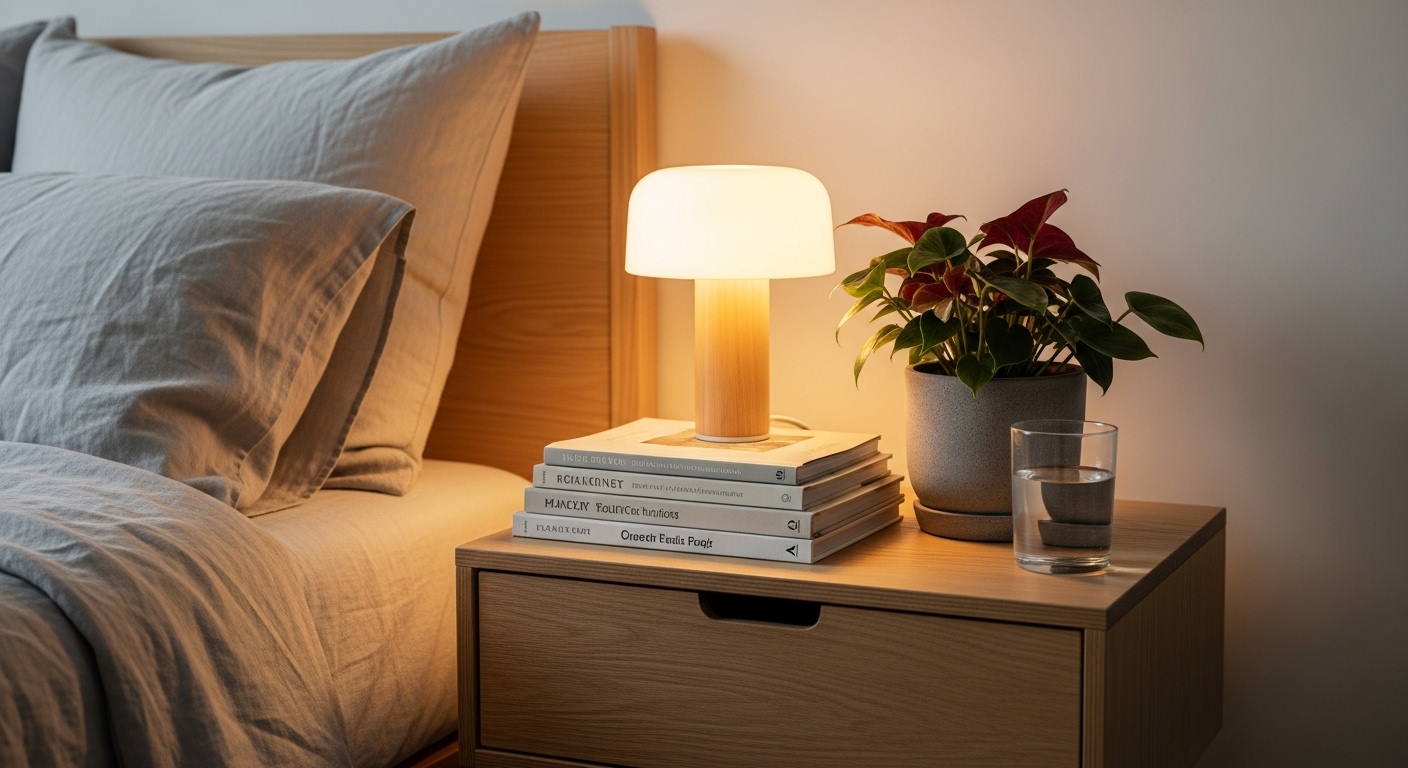
A light. Something to read. One decorative object, a small plant, a dish, a framed photo, a candle you actually light. That's the surface. A stack of two or three books counts as one thing if they're stacked; three books spread out count as three. A tray with a glass and a watch on it counts as one thing, which is the whole point of a tray. The phone charging counts as nothing if the cable comes up through a hole or a clip at the back and the phone lies flat, and as a thing if the cable is a white snake across the front. The reason three works is that the eye reads groups of three as composed and groups of five as "things that landed there," which is true of coffee tables, shelves and mantels as well as nightstands, and it's the least mysterious styling rule I know, which is why it's the one I actually keep.
The light: get it off the surface
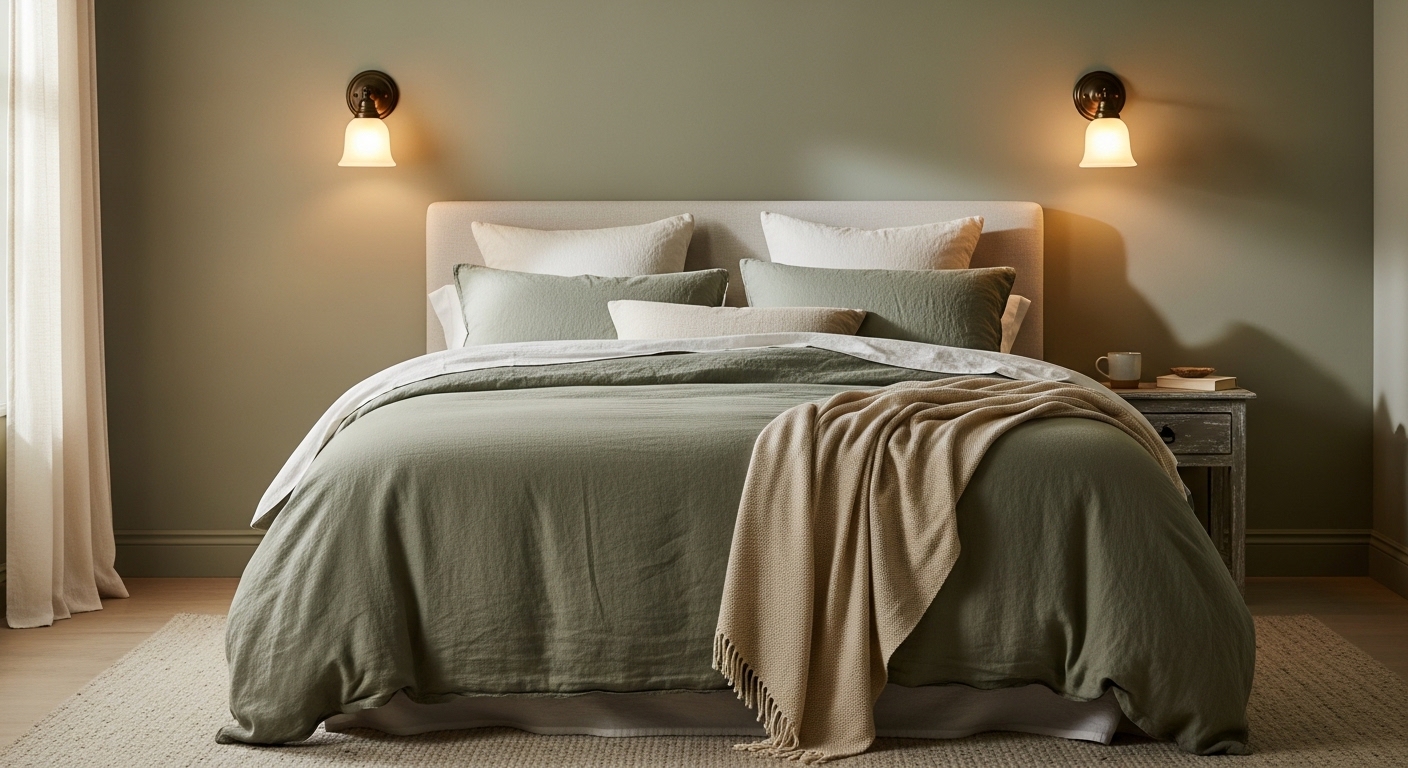
The lamp is the biggest thing on any nightstand and the one that takes the most surface, and the styling move that changed ours was removing it. A wall-mounted bedroom wall lamp or sconce above the nightstand, at 24 to 30 inches above the mattress, does the lamp's job from the wall, frees the whole surface, and puts the light where you read rather than where the lamp base happens to be. Ours are hardwired, the decision I wrote up in sconces versus ceiling lights; in a rental or a room with no wiring, a plug-in sconce with the cord dropped behind the nightstand does the same thing. If a table lamp is the light, it goes at the back corner nearest the wall, its shade no wider than a third of the nightstand, and it counts as one of the three. The bulb is 2700K and dimmable in either case, because a nightstand light is the last light on and the first one off.
The drawer system that makes the rule hold
A rule about the surface only works if there's somewhere for everything else, and "somewhere" has to be closer than the bathroom. Our nightstands have two drawers and each drawer has a job. Top drawer, nightly: lip balm, earbuds, the sleep mask, a pen, the notepad. Bottom drawer, occasional: pain reliever, a spare charging cable, tissues, the book I'm not reading yet. Cables live in a small open box on the floor behind the nightstand, plugged into a strip, with one cable up through a clip at the back to the surface. Before we had drawers I kept putting things on the surface because there was nowhere else for them, and the storage solved the clutter, which sounds obvious and took me longer than it should have to act on. A nightstand without a drawer needs a basket on its shelf, and a nightstand with neither is a stool.
Size and height: the numbers that make it look right
Height: the top of the nightstand within 2 inches of the top of the mattress, either way. Higher and you're reaching up for water; lower and the lamp is in your ear. Our mattress top is 25 inches from the floor and the nightstands are 24. Width: 18 to 24 inches for a queen, 20 to 28 for a king, and no wider than the gap between the bed and the wall minus 2 inches. Depth: 16 to 20 inches; deeper and the drawers hold more than you want to keep. Scale relative to the bed: a tall headboard takes a taller nightstand, a low platform bed takes a low one, and the pair should be the same height even if they're not the same piece.
Do nightstands have to match?
No, and ours don't. Mine is a two-drawer oak piece; my husband's is a vintage cabinet in a darker wood, because he needs a door for the things he owns. What makes the pair read as a pair is the same height, the same light above each one, and the same rule on top: three things. Matching nightstands are the safe choice and the one to make if you're buying new; mismatched ones need the height to agree and one material or color in common, and they're the more interesting choice if you have one piece already. A room with two matching nightstands, two matching lamps and two matching everything reads as a hotel, which is fine if you like hotels.
Styling the three things
The light at the back, or on the wall. The books at the front, stacked, largest at the bottom, spines facing the bed so you can read them lying down. The object on top of the books or beside them, and it should be shorter than the stack. Glass of water on a coaster or the tray. That's it, and it takes ten seconds to reset. Odd numbers, varied heights, and nothing tall at the front edge, which is where a hand reaches for the water in the dark. The candle is allowed only if it gets lit; an unlit candle is a decorative object that's also a fire risk near a book.
Nightstand styling on a small nightstand or no nightstand
A 14-inch nightstand takes two things, the light on the wall and a book with the glass on top of a coaster on it. A floating shelf at mattress height, 12 by 8 inches, screwed to studs, is the nightstand for a room where a piece of furniture won't fit, and it takes the sconce above and one book. A stool or a small side table with no storage takes a basket underneath for the drawer things. What none of them take is the phone charger snaking across the top; a clip at the back edge is $4 and it's the difference between styled and not, more than any object you'd buy.
What to put on a nightstand, by person
The rule is three things, but which three depends on who sleeps there, and pretending otherwise is how the rule fails. A reader's nightstand: sconce, the current book plus the next one stacked, a small dish for the glasses. A phone person's nightstand: sconce, the phone flat on a small tray with the cable through the clip, one plant. A parent's nightstand (mine, most nights): sconce, a book, and the monitor, which is the object, because it's there whether I style it or not and a rule that ignores reality gets ignored. My husband's: sconce, a glass of water on a coaster, the watch. Our daughter's, aged nine: a plug-in sconce she can reach, a book, a rock she found. The object is the personal part; the light and the reading are the constants.
Guest room nightstands
A guest nightstand gets the same three: a light the guest can find in the dark (a sconce with the switch on the fixture, not a lamp with a switch on the cord under the bed), a book or two you'd hand a friend, and a small carafe with a glass. Plus, in the drawer, the things a guest won't ask for: a phone charger with the common connectors, tissues, earplugs, a sleep mask. Ours has a card in the drawer with the wifi password, which guests mention more than anything else in the room. A guest nightstand is the one place I'd break the three-things rule for a small vase of something from the yard, because it's a message rather than an object.
The five-minute reset
Every Sunday: everything off the surface, wipe it, the nightly things into the top drawer, the migrants (the living room remote, the kitchen coaster, the mug) back to their rooms, three things back on top. Five minutes for both sides. The reason it works isn't discipline; it's that the drawers have jobs, so putting something away is one decision, not a search for a home. The drift starts on Tuesday and is fully back by the following Saturday, and that's fine. Styling isn't a state; it's a reset, and a reset that takes five minutes is one that happens, which is the same thing I'd say about a project plan.
Materials and finishes that survive a nightstand's life
A nightstand takes water rings, a hot mug, a dropped phone and a hand that reaches in the dark, so the surface has to forgive. Solid wood with an oil or matte lacquer finish takes a water ring and gives it back with a rub of oil; a glossy lacquer or a mirrored top shows every one and keeps it. Veneer is fine if the edges are banded and the top is sealed. Marble tops look right in photographs and etch under a glass of anything; ours would have needed coasters on the coasters. Metal legs and a wood top is the combination that has held up in our house, and it's also the lightest to move on cleaning day. Whatever the material, it should match something else in the room, the bed frame, the dresser, the floor, or the sconce finish, so it reads as chosen rather than surviving from a previous apartment, which is the origin of most nightstands I've seen. The finish rule applies here: the sconce above the nightstand and the hardware on it agree, and the wood can be whatever the room already has.
What the styled nightstand actually looks like at 10 pm
A sconce glowing at 30 percent above a 22-inch oak nightstand. Two books stacked at the front left, spines toward the bed. A small ceramic dish on top of them with my rings in it. A glass of water on a cork coaster at the front right. The phone flat at the back, cable through the clip, screen down. Nothing else. It took a rule, two drawers with jobs, a wall light, and a Sunday reset to get there, and it has stayed there, give or take a Tuesday, for three years now. I can't say that about any other surface in the house, including the ones I've written more about.
The nightstand I'd buy again, and the one I wouldn't
Buy again: a two-drawer, solid wood or veneer, 22 inches wide, 24 tall, with a small lip at the back to stop things sliding down the gap, and legs rather than a solid base so the floor shows and the piece looks lighter. Ours was $240 each secondhand and refinished. Wouldn't: the mirrored one I bought in our first year, which showed every fingerprint, every cable, and every glass ring, and which made the rule impossible because the surface itself was the clutter. Also the open-cube style with no drawer, which is a shelf pretending to be storage. The nightstand is furniture you touch every night and morning; buy the one with the drawer, put the light on the wall, and keep three things on top.
Shop this post: bedroom wall lamps and plug-in wall sconces