There are four bathroom faucet types you can install on a standard sink, single-hole, centerset, widespread and wall-mount, and the one you can buy is decided by the holes already drilled in your sink, not by the catalog. That's the spec I wish someone had told me before I bought three faucets for one bathroom. My first faucet matched the vanity finish perfectly and was physically unable to install because it was a widespread and my sink had one hole. My second was the right configuration in brushed nickel, ordered the week I'd decided on matte black everywhere else. The third went in and has been there for four years. This is the guide I'd have wanted: the four types and how to identify yours in thirty seconds, the finishes that hold up, the spout height and reach numbers that stop a faucet splashing, valves, price tiers, what's worth paying for, and the two returns I could have skipped.
Start with the sink: count the holes
Look under the sink, or take the old faucet off, and count. One hole, usually 1-3/8 inches across, takes a single-hole faucet. Three holes 4 inches apart, center to center, take a centerset faucet, which is one piece with the handles built in. Three holes 8 inches apart (sometimes 6 to 16 on older sinks) take a widespread faucet, three separate pieces. No holes in the sink and a plumbing stub in the wall means a wall-mount. That's it. This one fact eliminates most of the catalog immediately and would have saved me the first return. Adapter plates exist to put a single-hole faucet on a three-hole sink, and I'd use one if I loved the faucet, but a widespread cannot go on a single-hole sink without a new sink, which is how you end up with a faucet in a box in the garage, or in my case, a return label and a lesson.
The four bathroom faucet types, and who each suits
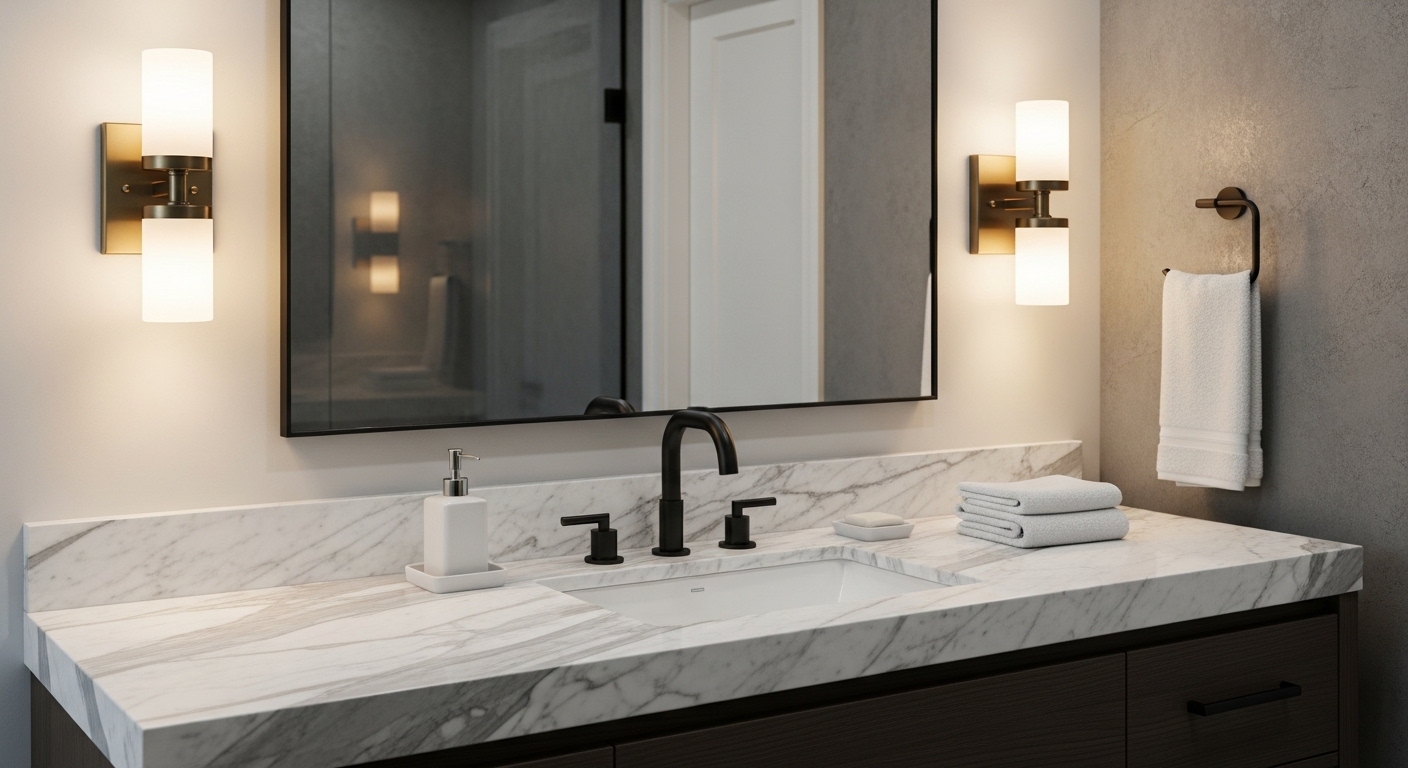
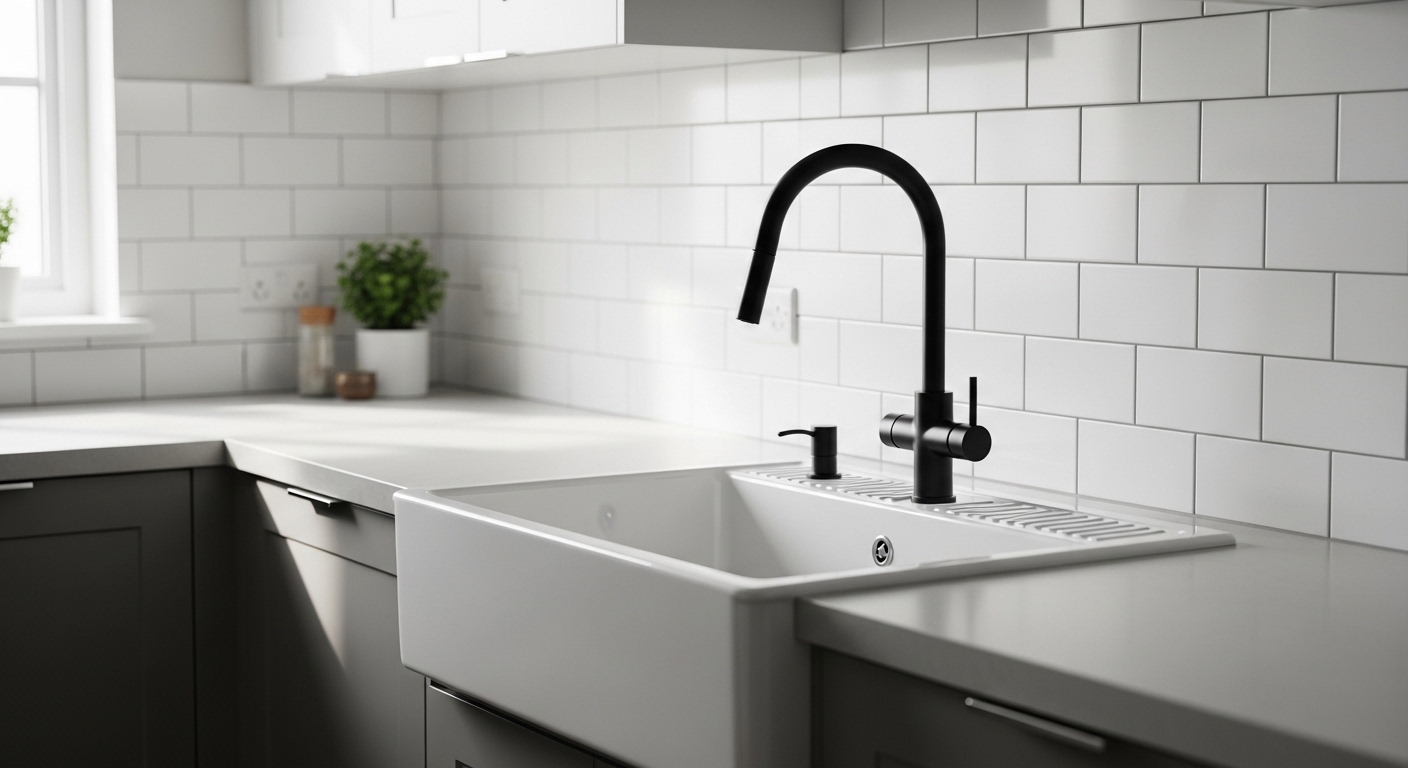
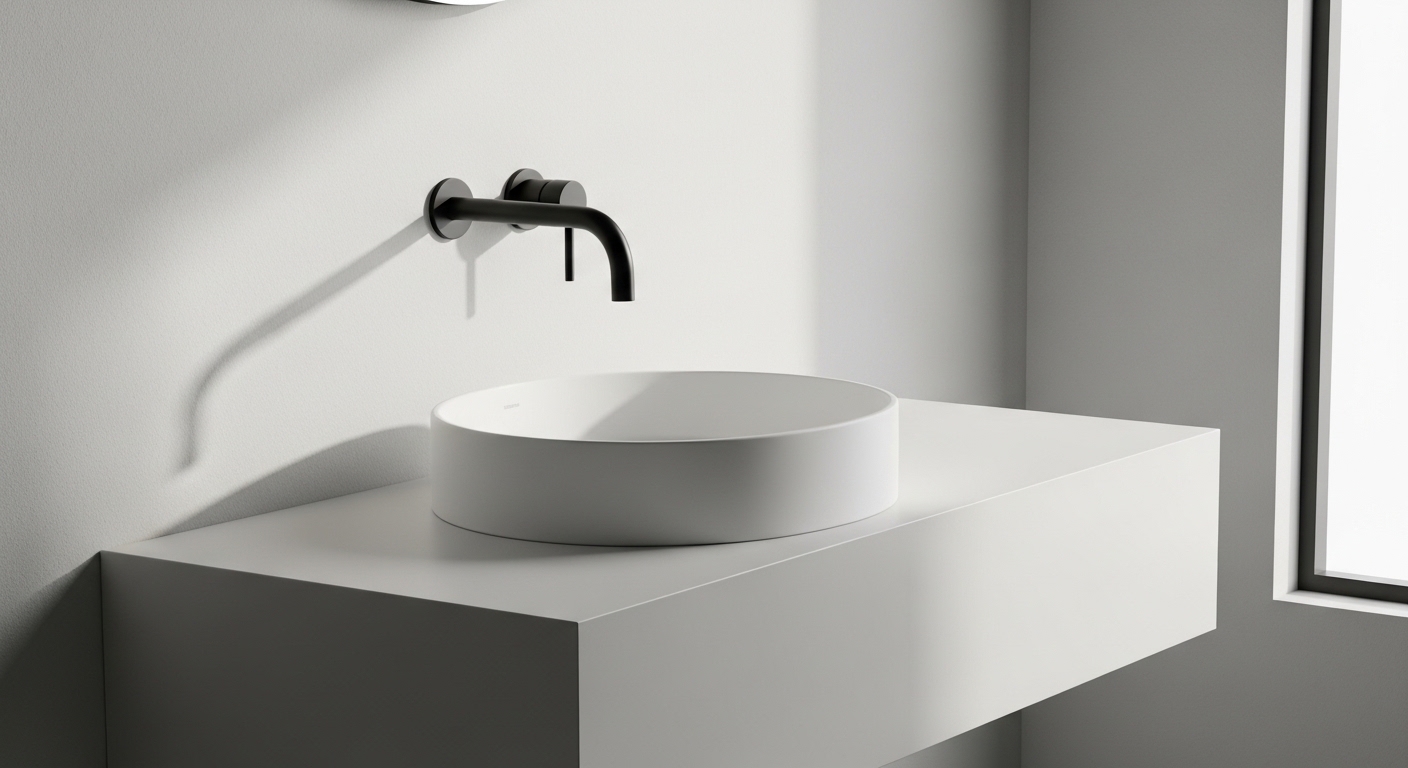
Single-hole: one spout with an integrated lever, cleanest look, easiest to wipe around, best for small vanities and vessel sinks (in a tall version), and the most common new-sink configuration. It's what's in our main bathroom. Centerset: the compact three-hole faucet with two handles on a 4-inch base, the standard in older bathrooms and apartments, inexpensive, and the one to buy when you're replacing like for like in a hurry; our powder room has one because the 1964 sink does, and the sink is staying because it's pink and I've come around to it. Widespread: spout and two separate handles 8 inches apart, the most formal and the most expensive, needs a wider counter and a plumber who's patient, and looks right on a long double vanity. Wall-mount: spout and handles come out of the wall above the sink, the cleanest counter of all, and the only one where the plumbing is decided before the tile goes on, so it's a renovation choice, not a replacement one.
Spout height and reach: the numbers that stop splashing
Reach is the distance from the base of the faucet to the middle of the water stream, and it should land the water over the drain, or within an inch or two of it. Too short and you wash your hands against the back of the basin; too long and it splashes off the front. Measure from the faucet hole to the drain center on your sink and buy a reach within 1 to 2 inches of that; most bathroom faucets are 4 to 6 inches, and our sink needed 5. Height matters for vessel sinks, which sit on the counter and need a tall faucet (12 inches or more) or a wall-mount, and for shallow basins, where a tall arched spout drops the water from far enough up to splash. A standard undermount or drop-in basin takes a spout 5 to 8 inches tall, and the box will list both numbers if the maker wants you to succeed. The widespread I returned would have been 2 inches short on reach even if it had fit.
Finish: match the most visible hardware, then buy the durable version
Match the faucet finish to the most visible fixture in the room, usually the sconces or the towel bar, not the mirror frame. If the sconces are matte black, the faucet is matte black. Mixing warm metals (brass, bronze, gold) with cool ones (chrome, nickel) can work on purpose, but it takes more confidence than matching and it's easy to make look like an accident; I keep one finish per bathroom and use the three-finish rule across the house. Durability by finish, from four years of wiping ours and six of my mother's: chrome is the toughest and the hardest to keep spot-free; brushed nickel hides water marks best; matte black is more durable than it was five years ago but shows mineral deposits on hard water and needs a soft cloth, never anything abrasive; unlacquered brass patinas, on purpose, and either you love that or you don't. PVD finishes, which the box will mention, are the ones that last; a painted or plated matte black without PVD will wear at the handle in a couple of years.
Valves, and why the inside matters more than the outside
Inside every faucet is a valve, and it's what fails. Ceramic disc valves are the standard in anything decent now, drip-free for years and serviceable with a cartridge if they do; compression valves, with rubber washers, are what's in a $30 faucet and in the powder room faucet that dripped for the last two years of its life. Look for "ceramic disc" or "ceramic cartridge" on the spec sheet, a lifetime warranty on the valve, and a brand that sells replacement cartridges separately, because a faucet you can't get a $15 cartridge for is a faucet you replace. Flow rate: 1.2 gallons per minute is the standard for a bathroom faucet now, and it's plenty; the 1.5 and 2.2 gpm ones only matter in a kitchen.
Price tiers, and what you get at each
Under $80: a working faucet, usually centerset or single-hole, often with a compression valve and a thin finish, fine for a rental or a powder room you'll redo. $80 to $200: ceramic disc valves, solid brass bodies, PVD finishes on the better ones, and the tier where most of the good-looking faucets live; ours was $164. $200 to $450: heavier bodies, better finishes, designer shapes, widespread sets. Over $450: you're paying for a name and a shape, and the valve inside is often the same one as the $200 faucet. The bathroom faucets I'd point people to are in that middle tier and are sorted by configuration, which is the research step that would have saved me a return. Anything sold without stating the valve type or the hole configuration is telling you something, and what it's telling you is to keep scrolling.
Handles: lever, cross, knob, or touchless
A single lever is the easiest to use with wet or soapy hands and the easiest for a child or an older parent, and it's what I'd choose for any bathroom that gets daily use; ours has one. Cross handles look right on a widespread in a traditional bathroom and are slightly fussier to operate and clean. Knobs are what came on the 1964 centerset in the powder room and are the reason a compression valve is a chore to turn off fully. Touchless faucets belong in a kitchen where your hands are covered in chicken; in a bathroom they add a battery, a sensor that fires when you reach for the soap, and a $150 premium for a problem nobody has. Whatever the handle, check the lever swings the way your counter allows: a lever that swings back into a backsplash or a mirror is a lever that gets used half-open forever.
Matching the faucet to the sconces, the mirror and the towel bar
The faucet is the fixture people touch, so it's the one they notice, and it sets the finish for the room. Our order of decisions, corrected after the returns: sconces first, because they're the biggest visual element and they're on the wall at eye height; faucet second, in the same finish; towel bar, hooks and paper holder third, same finish, cheapest tier because they're small; mirror frame last, and allowed to differ, because a wood or black frame reads as furniture rather than hardware. The lighting side of that decision is in my bathroom lighting post. What I'd never do again is choose the faucet first because it was the thing I was excited about; the faucet is the size of a hand, and the sconces are the size of the wall.
Installation: what a plumber does that you can't, and what you can
Replacing like for like, a centerset for a centerset or a single-hole for a single-hole, is a two-hour job with a basin wrench ($12), plumber's tape and a bucket, and I've done two. Changing configuration, going from three holes to one with a deck plate, is still doable. Going to a widespread, or to a wall-mount, or anything that involves the supply lines being in the wrong place, is a plumber, and ours charged $190 to install the widespread on the double vanity in my mother's house. Whatever you do, replace the supply lines at the same time ($14 for two braided ones); the old ones are the same age as the faucet you're removing and they fail in the same year, usually while you're on vacation.
Keeping a faucet looking new
Once a week, a damp microfiber cloth and then a dry one, which takes thirty seconds and is the whole routine on a PVD finish. Never a scouring pad, never a bleach spray, never the "bathroom cleaner" with the warning label, on any finish, because the finish is thinner than it looks. Hard water, which we have in Portland only mildly, leaves white deposits at the base of the spout that come off with a cloth dampened in white vinegar and rinsed immediately; left for a month they etch matte black. The aerator, the little screen at the tip of the spout, unscrews and cleans in vinegar twice a year and is the reason a four-year-old faucet still runs in a clean stream rather than a spray. Ours has had the aerator cleaned eight times and the cartridge never, which is what a $164 faucet with a ceramic valve is supposed to deliver.
Our three faucets, evaluated
Faucet one, widespread, brushed brass, $240: wrong configuration, returned, $18 shipping. Faucet two, single-hole, brushed nickel, $155: right configuration, wrong finish against matte black sconces and towel bar, returned, $14 shipping. Faucet three, single-hole, matte black PVD, ceramic disc, 5-inch reach, $164: installed in an afternoon, cleaned with a microfiber cloth weekly, no drips, no wear at the lever in four years. The lesson, in project-management terms, is that requirements came before selection and I did selection first, twice. Count the holes. Measure the reach. Pick the finish that's already in the room. Then, and only then, open the catalog, and read the spec sheet before the photos, which is advice I give about most things now.
Faucet types and the sinks they go with, in a sentence each
Undermount and drop-in basins with one hole: single-hole. The same basins with three holes 4 inches apart: centerset, or single-hole with a deck plate. Three holes 8 inches apart, or a long counter: widespread. Vessel sink: tall single-hole or wall-mount. Pedestal sink: whatever holes it came with, usually centerset, and check the reach because pedestals are shallow. Trough or double-basin vanity: two single-holes or two widespreads, matched, never one of each. Wall-mount with any sink: only if the plumbing is already in the wall or the wall is about to be open, and only with a plumber who has done one before.
Shop this post: bathroom faucets and bathroom sink faucets by configuration