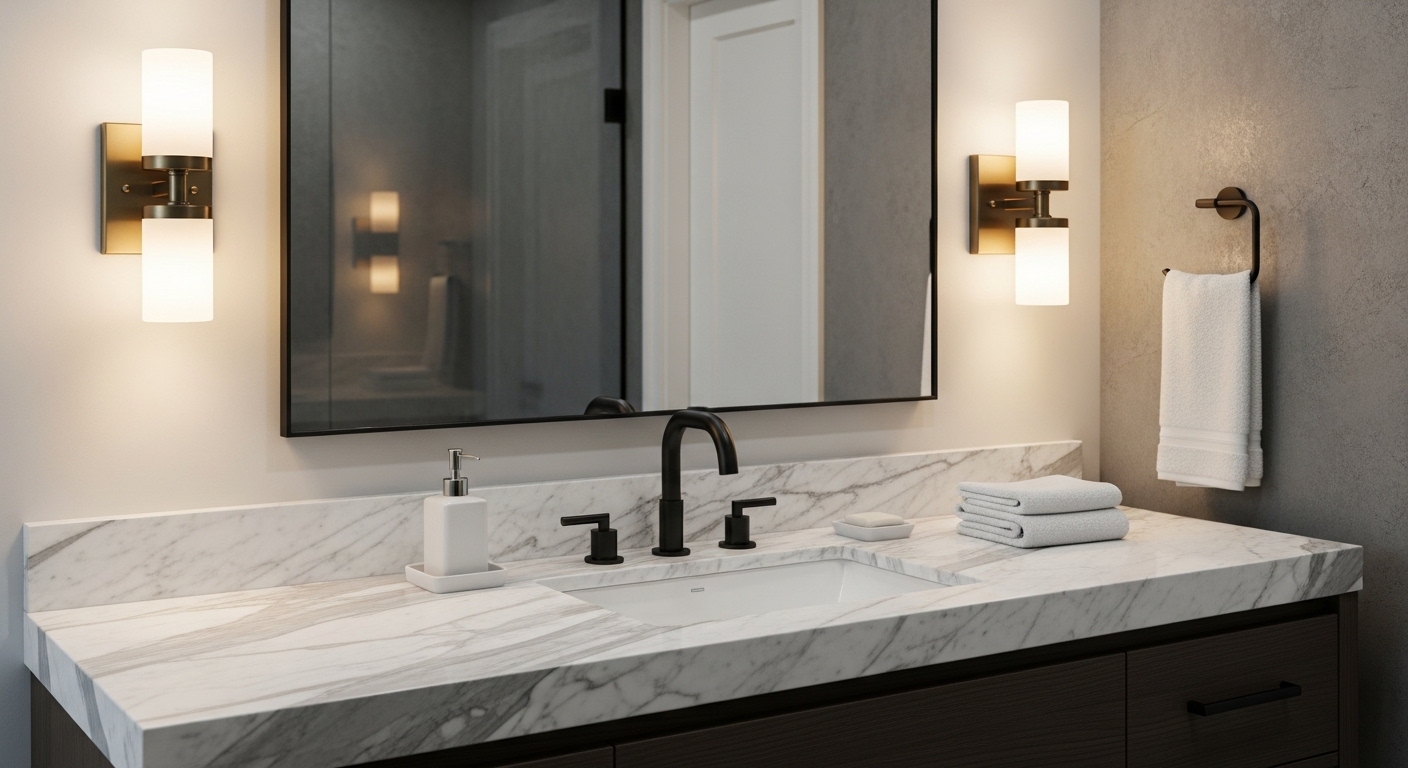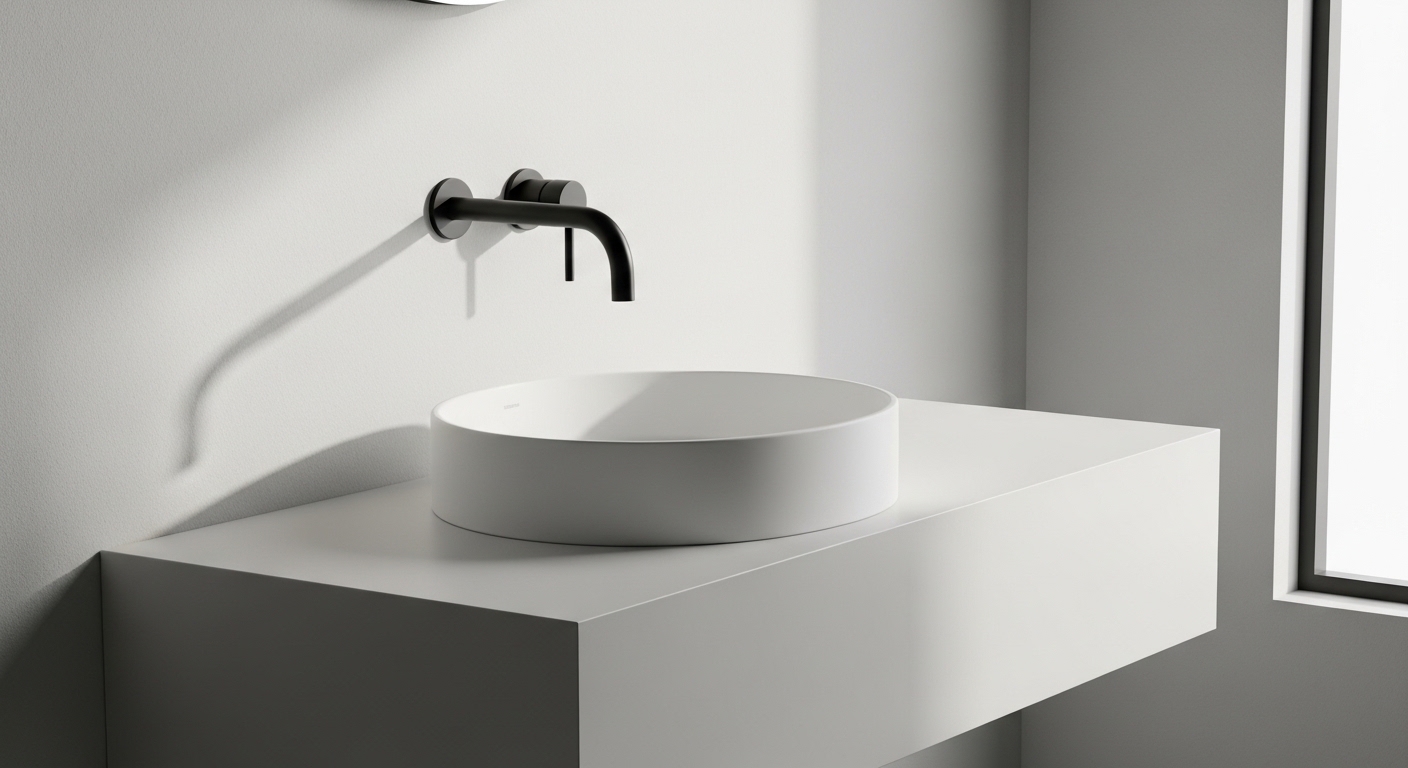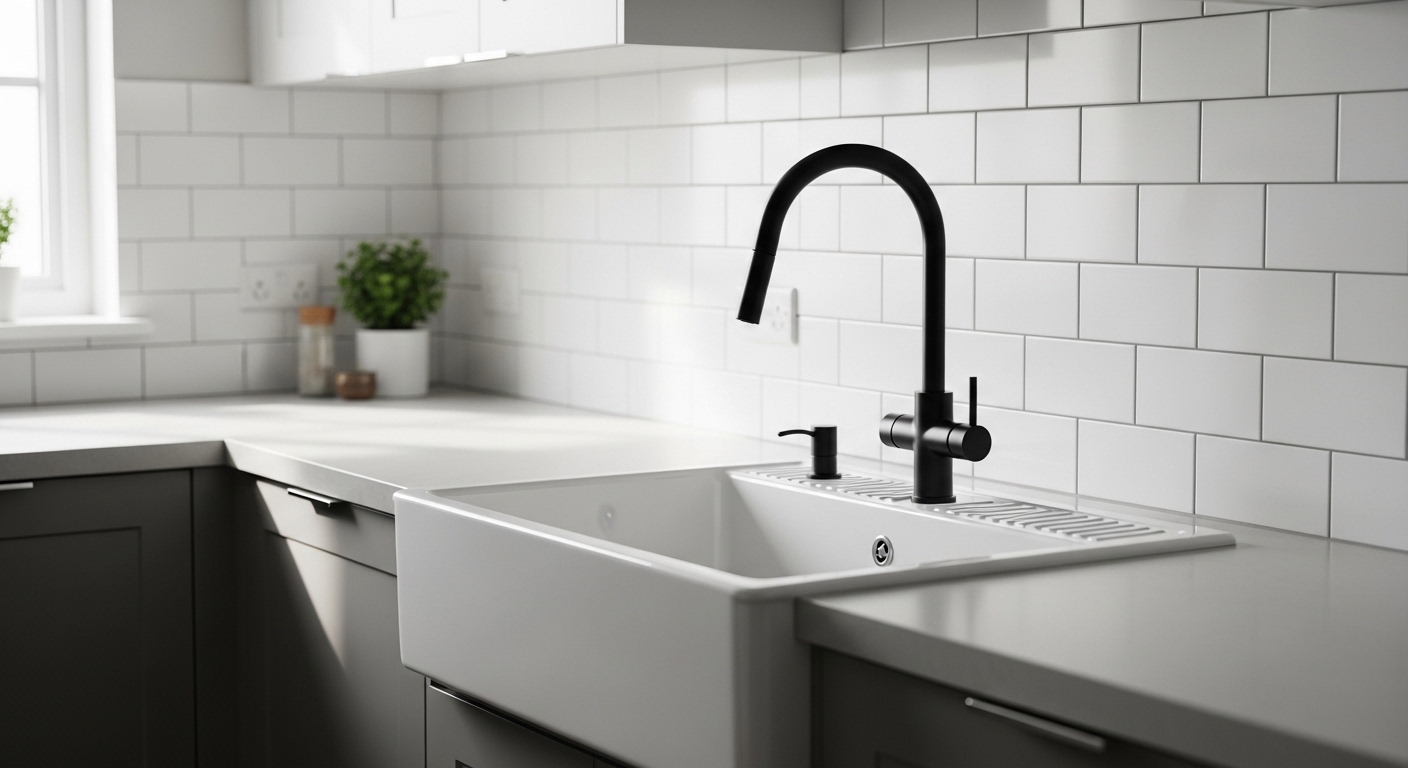
A matte black kitchen faucet shows water spots and soap residue, hides fingerprints almost completely, needs a wipe every couple of days to stay perfect, and is worth it if your kitchen needs one dark anchor and you buy a PVD finish rather than a painted one. That's the fourteen-month accounting from our kitchen, a white shaker kitchen with butcher block counters, stainless appliances and brass glass pendants over the island, in a 1964 Portland ranch, where two people told me I'd regret the black faucet because of water spots and my husband voted for brushed nickel. He conceded at month three. This post is the honest maintenance, what a matte black faucet does to a white kitchen, PVD versus painted and how to tell before you buy, the finish and the pendants and the hardware, spray head and pull-down mechanics, hard water and what to do about it, the cleaning that works and the cleaner that ruined a friend's, how it's aged at fourteen months, the black bathroom faucet question, what it cost, mistakes, and whether I'd buy it again.
The honest maintenance
Water spots: yes, they show, as pale dots on the black when the water dries, and more when the water's hard. Soap residue: also visible if you don't wipe it down, as a grey haze at the base. Fingerprints: barely at all, which is the opposite of chrome and the thing nobody warns you is a benefit. Scratches: none, on the PVD, in fourteen months of pans and a nine-year-old. The maintenance trade-off is real and not dramatic: a quick wipe with a dry microfiber cloth every couple of days keeps it perfect, and a wipe with a damp one and then a dry one once a week does the base. That's about ninety seconds a week, which is less than the chrome faucet took to look clean, because the chrome showed fingerprints the moment anyone touched it.
What black does to a white kitchen
The kitchen has white cabinets, butcher block counters and stainless appliances, and before the faucet it had no dark anchor: everything was pale or shiny, and the room read as unfinished in a way I couldn't name. The matte black faucet added the one dark point the space needed, at the sink where the eye goes, and it made the whole kitchen feel more considered. It's the same trick as a black picture frame on a white wall: one dark line organizes the pale things around it. Since then the cabinet pulls went matte black too, and the two together are the kitchen's graphic layer against the brass of the pendants, which is the other accent and the reason the room isn't all black and white.
PVD versus painted, and how to tell before you buy
The most important spec nobody mentions. PVD, physical vapor deposition, bonds a thin layer of metal to the faucet body in a vacuum chamber and creates an extremely durable finish that resists scratches, chips and cleaners. Painted or powder-coated black looks identical in photos and chips over time, at the edges of the handle first, then at the spout where pans hit, and once it chips it can't be fixed. To tell: the product page says PVD or "physical vapor deposition," and the price is higher, usually $150 and up against $60 to $90 for painted; if the listing says "matte black finish" and nothing else at $70, it's painted. Ours is PVD, and the friend whose faucet chipped in a year had bought the $65 one that looked the same in the box.
Matching the finish: pendants, hardware, the rest
Matte black at the sink, matte black cabinet pulls, and brass pendants over the island and a brass light over the sink: two metals, one dark and one warm, which is the rule I'd give anyone mixing finishes. Three metals is a hardware store. The faucet doesn't have to match the pendants; it has to match the pulls and the other things at hand height, and the lights can be the second metal. A matte black faucet with chrome pulls is the mistake, because chrome next to matte black looks like a mistake, whereas brass next to it looks like a decision. The brass versus black post is the longer version.
Spray head, pull-down, and the mechanics
A pull-down faucet with a single handle and a magnetic dock for the spray head, two spray modes, and a ceramic cartridge. The pull-down hose is the part that fails first on any faucet and the one to check reviews for; ours has had fourteen months of daily pulling and docks with a click. The spray head is matte black too, and its face, where the water comes out, is the one part that shows mineral buildup, which a toothbrush and vinegar fix monthly. Height: 16 inches to the spout top, which clears a stockpot and fits under our window sill, which is the measurement people forget.
Which black: matte, satin, or gunmetal
Matte black is the flat, slightly soft black that reads as a line and hides fingerprints; it's the one on our sink. Satin black has a faint sheen and shows a little more of everything and looks a little more like metal. Gunmetal or "black stainless" is a dark grey with a brushed texture that hides water spots better than either and reads as less of a decision. If the kitchen needs an anchor, matte; if the water is hard, gunmetal; and whichever it is, the pulls should be the same one, because two blacks in one kitchen look like two attempts.
Installing it, and the 1964 supply lines
A pull-down faucet installs from above with a single mounting nut and a weight on the hose, and it's a homeowner job in a new house with braided supply lines and shutoffs under the sink. In ours the shutoffs were the original 1964 gate valves that didn't shut, and the supply lines were rigid copper to a three-hole faucet that the new single-hole faucet covered with a deck plate. The plumber's hour was for the valves and the lines; the faucet itself took him ten minutes. If the shutoffs under your sink are old, budget the plumber, and replace the valves while he's there, because the faucet will outlast them.
Hard water, which is the real variable
Portland water is soft, and that's why the spots are a wipe and not a project. With hard water, a matte black faucet shows white mineral spots that a dry cloth doesn't remove, and the routine is a damp cloth with a drop of dish soap, then dry, every day or two, and a vinegar-and-water wipe weekly. If your water is very hard, the honest answer is that black is more work than nickel, and a filter at the tap or a softener changes the equation more than the faucet does. Ask a neighbor with a black faucet before you buy; the same faucet in Phoenix is a different faucet.
Cleaning that works, and the cleaner that ruined a friend's
Works: a dry microfiber cloth; a damp microfiber with a drop of dish soap, then dry; diluted white vinegar on a cloth for spots, rinsed and dried; a soft toothbrush on the spray face. Ruins: anything abrasive, any powder cleanser, any cloth that isn't soft, and, the one that got a friend's painted faucet, a bathroom cleaner with bleach that took the finish off in a haze in one wipe. PVD tolerates more than painted but the rule is the same: nothing you wouldn't use on your glasses. The daily wipe is the whole routine, and it's less than chrome needed.
Fourteen months in
No chips, no scratches, no fading, no haze. The finish looks as it did in the box, which is what PVD is for. The spray head has needed the toothbrush three times. The handle is smooth, the dock clicks, the hose retracts. My husband, who initially voted for brushed nickel, admitted at month three that it was the right call, and at month fourteen he wipes it down without being asked, which is the review. The two people who said I'd regret it both have chrome faucets that show every fingerprint, and I've said nothing.
The bathroom faucet question
If you love the look in the kitchen, the same matte black in the bathrooms gives a cohesive house, and the bathroom faucet has an easier life than the kitchen one, less pan-banging, fewer spots because the tap runs shorter. Ours is black in the main bathroom, where the medicine cabinet frame and the hooks are black too, and nickel in the other, where the hardware was already nickel; the bathroom faucet guide is the choosing. The bathroom faucets come in the same matte black, and the rule is the same: PVD, and match the hardware at hand height.
The sink, the counter, and what shows spots more
A black faucet over a white undermount sink is the highest-contrast version and the one where a spot on the faucet is visible from the door; over a stainless sink the faucet is the dark thing and the sink's own spots share the blame; over a black composite sink the faucet disappears into it and the anchor is lost. Ours is over white, which is the version that needs the wipe most and looks best. On butcher block the faucet's base is on oiled wood, and the drip line from the spray head is the one place the counter needs the oil more often; on stone, the base collects a ring of soap that the weekly damp wipe handles. The faucet is one dark line, and the sink and counter decide how much of a line.
Sconces, pendants and the faucet: the metals in one sightline
Standing at the sink you see the faucet, the pulls, the window, and the light over the sink, and those four should be two metals at most. Ours are black, black, and the brass pendant over the sink, and the brass over the island behind. The pendant post is why the pendants are brass and glass; the short version is that black lights over a black faucet would have made the kitchen a diagram, and brass over black makes it a kitchen.
What it cost
The faucet, PVD matte black pull-down, $210. The plumber for an hour, because the old faucet's supply lines were the 1964 kind, $120. The cabinet pulls that followed it, $90 for twelve. About $420 for the kitchen's dark anchor, and $65 would have bought the painted one that looks the same for a year and then doesn't.
Mistakes
Nearly buying the $65 painted one, saved by a review with a photo of a chip. Chrome pulls for the first month, before the black ones. A bleach spray on the first week's spots, one wipe, on the PVD, which survived it and shouldn't have been asked to. And listening to the two people, for about a month, before deciding that a faucet is a thing you wipe anyway.
In one paragraph
Buy PVD, not painted; match the pulls the same week; use brass or one warm metal for the lights; wipe with a dry cloth every couple of days and a damp one weekly; keep bleach and powders away from it; and if your water is hard, ask a neighbor first or choose gunmetal. Spots are a rumor with soft water and a fact with hard.
Would I buy it again?
Yes, PVD, and I'd match the pulls the same day and put the brass on the ceiling. A matte black kitchen faucet is ninety seconds of wiping a week for one dark line that makes a white kitchen look like someone decided, and in a kitchen with soft water and a PVD finish the water spots are a rumor. In a kitchen with hard water and a painted finish, they're a fact, and the difference is the spec on the box and the neighbor you asked.
Shop this post: faucets in matte black and kitchen pendant lighting in brass for the second metal