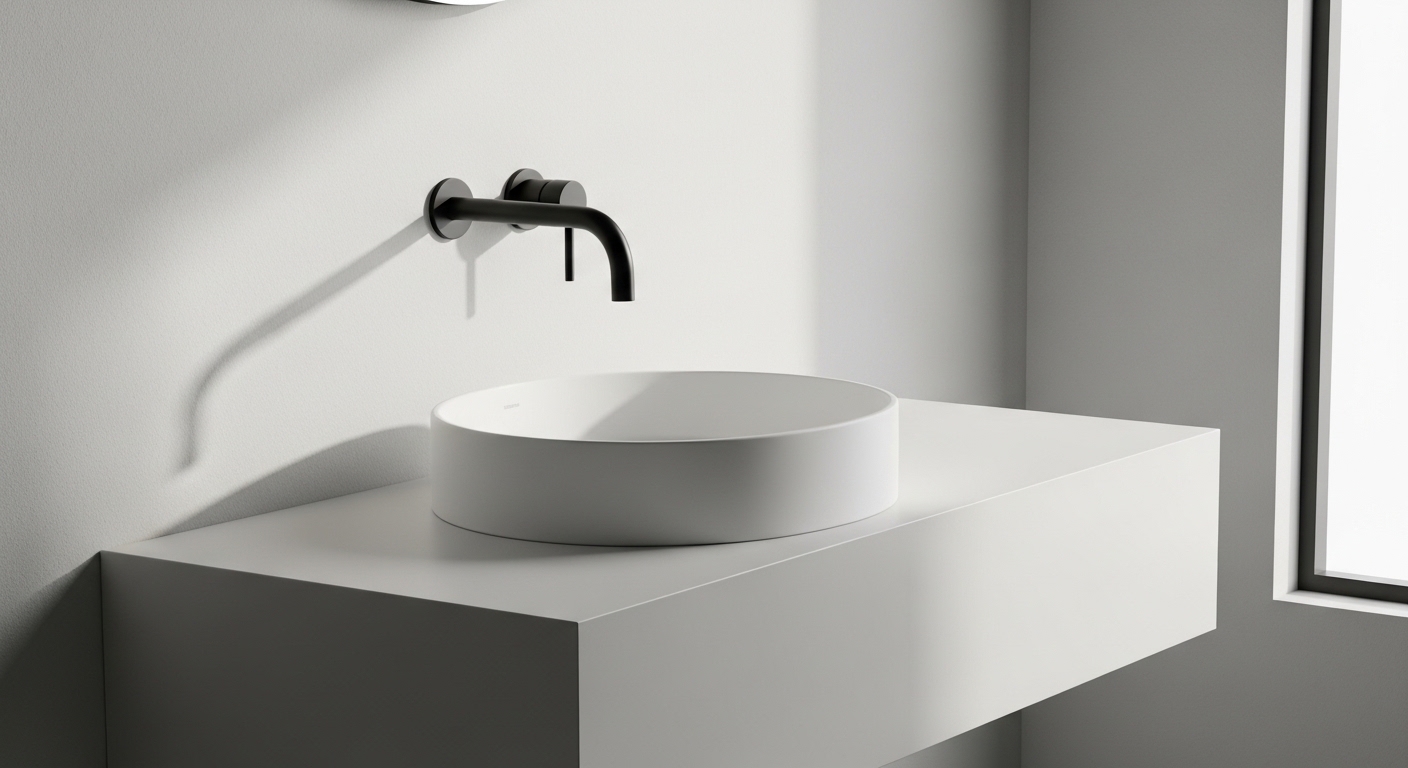
The most common bathroom lighting mistake is a single overhead fixture and nothing else, and the fix is a pair of sconces at the sides of the mirror, mounted at 60 to 65 inches, on their own dimmer. I know because I made the mistake in full, with a budget and a schedule. I spent months sourcing the travertine. I hired a plumber for the new vanity. I agonized over the faucet finish for two months. And then I installed one overhead light, centered in the ceiling, and called the project done. Three months later I noticed I couldn't apply mascara without leaning into the mirror until my nose touched it. This post is the mistake, the reasoning behind why it's the default in nearly every builder bathroom, the fix with exact heights and spacing, the three fixtures I bought before the right one, the bulbs, the dimmer setup we use morning and night, and what the whole thing cost in our 1964 Portland ranch.
Why a single overhead light fails at a bathroom mirror
A ceiling light illuminates the top of your head. It does not illuminate your face. Light from directly above lands on the forehead, the brow ridge and the tip of the nose, and everything under those, the eye sockets, the underside of the nose, the jaw, falls into shadow. Those shadows are the exact opposite of what you need at a mirror; they're the lighting a photographer uses when they want someone to look ten years older. It's also the cheapest setup there is, one box, one fixture, one switch, which is why builders default to it and why our bathroom came with it. As a project manager I'd have called it "meets spec." It met the spec for a room to be lit. It did not meet the spec for a room where people look at their own faces every morning.
The fix: sconces at the sides of the mirror, at face height
A pair of bathroom sconces flanking the mirror, mounted with the center of the light at 60 to 65 inches from the floor, which is eye level for most adults, and spaced 28 to 36 inches apart, or just outside the edges of a mirror up to 36 inches wide. Side light hits the face from two directions and fills the shadows the overhead creates. The overhead stays, on its own switch, for cleaning the floor and finding a dropped earring; the sconces are what make the mirror usable. Ours are at 62 inches, 32 inches apart, on either side of a 30-inch mirror, and the difference on the first morning was the kind of thing you photograph and send to your sister, which I did, with a before picture from three months earlier that she described as "a crime scene."
Two placement rules that people get wrong even after they've bought sconces. First, sides, not above: a bar of lights above the mirror is a better overhead, but it's still an overhead, and it still shadows the eyes. Second, at face height, not at "a nice height on the wall": sconces mounted at 70 inches, which is where they end up when you install them from a ladder, light the top of the mirror and the ceiling and miss the face. Measure from the floor, mark 62 inches, and put the center of the shade there.
The three fixtures I bought before the right one
The first pair was a set of clear-glass globe sconces. Lovely in the box; at eye level with a bare LED bulb they were two small suns, and I squinted every morning for three weeks before returning them. Clear glass at face height needs a frosted or filament bulb on a dimmer, and I hadn't planned for a dimmer yet. The second pair was matte black with a downward-facing shade, which sent all the light to the counter and none to my face; a bathroom sconce needs to throw light sideways, which means an open or diffused shade at the level of the eyes. The third, which stayed, is the Livi: the teardrop arm keeps the opal globe right at face level, the glass diffuses the bulb so there's no glare, and the brass matches our vanity hardware. It's the fixture I wish I'd found before the other two, and the return shipping on the first two cost $31, which I've mentally added to its price.
Bulbs and color temperature for a bathroom
2700K to 3000K, and nothing higher. We run 2700K in the sconces to match the rest of the house, and I'd accept 3000K if you do a lot of makeup and want colors a shade truer; 4000K and up, the "bright white" and "daylight" bulbs, make skin look grey and tile look like a hospital. CRI of 90 or above matters more in a bathroom than any other room, because the whole point is seeing your own face accurately; an 80 CRI bulb flattens skin tones even at the right color temperature. Lumens: 450 to 600 per sconce, 800 for the overhead. All dimmable, which brings me to the part that made the room actually work.
The dimmer setup we use morning and night
The sconces are on a separate dimmer from the overhead. Morning routine: both on full, sconces for the face, overhead for the floor. Evening: sconces at 30 percent, overhead off, and the room goes from bathroom to somewhere you'd take a bath. Two switches, one dimmer, about $28 in parts and an hour for the electrician who was already there for the vanity. It's the single cheapest part of the project and the part that changed how the room feels, and I'd have skipped it if I hadn't been standing there when he asked.
Bathroom lighting ideas beyond the mirror
Once the mirror is solved, the rest is layering, and a bathroom only needs two more things at most. If the ceiling height allows, a pendant over a freestanding tub, with the bottom at least 8 feet above the tub rim to satisfy the electrical code, makes the room feel designed rather than fitted; ours doesn't have the height, so a small sconce on the wall beside the tub does the job at 30 percent on the same evening dimmer. A light inside the shower, a damp-rated recessed fixture or a sealed flush mount, because a dark shower in a bright bathroom is a hole in the room. And a low nightlight, a plug-in at outlet height on a dusk sensor, so nobody turns the overhead on at 3 am. That's four layers: mirror, overhead, one accent, one night. More than that in a bathroom our size is a lighting showroom. The placement rules for every one of those fixtures are in a separate post, because they're the same rules in every room.
The mirror, the finish and the tile: what the sconces have to work with
Three decisions that affect the lighting more than any fixture choice. The mirror: bigger is better, because a mirror doubles every sconce it reflects; our 30-inch mirror is as wide as the vanity allows, and a 24-inch one would have needed the sconces closer together and lower. Frameless or thin-framed, so the sconces can sit tight against the edges. The finish: the sconces match the faucet and the towel bar, not the mirror frame; we use brass across the fixtures in this bathroom, matte black in the powder room, and the rule for choosing is in my brass versus black post. The tile: pale tile and a pale wall reflect the sconces back into the room and let you get away with 450 lumens each; the charcoal tile my husband wanted would have needed 800 and a third fixture. We chose the travertine before we chose the lighting, and it turned out to be the right order by luck, which is not a project management method I recommend.
What if your bathroom has one box above the mirror and no side boxes?
Ours did, and there are three answers in ascending order of cost. Cheapest: put a horizontal bar fixture with two or three opal shades in the existing box and point the shades sideways, which gets you partway to side light for $80 and no electrician. Better: plug-in sconces on either side of the mirror with the cords run behind the mirror to the vanity outlet, which is what I'd do in a rental and what my daughter's bathroom has. Best: have the electrician add two boxes at 62 inches while the wall is open for the vanity plumbing, which is what we did, and which cost about $220 for the two boxes and the wiring because the wall was already open. If the wall isn't open, the plug-in route is the sensible one.
Small bathroom, powder room, and the bathroom with a window
The rule scales down without changing. In our powder room, 5 by 6 feet with a 24-inch mirror, a single sconce on one side would have been lopsided, so it has two small ones at 60 inches, 26 inches apart, on a dimmer, and no overhead at all; the room is small enough that the sconces light the floor. A bathroom with a window beside the mirror has one side lit by day and dark by night, which fools people into thinking they need only one sconce, on the other side; they need two, because the window is black at 7 am in a Portland winter. And a long double vanity takes three sconces, one at each end and one between the mirrors, at the same 60 to 65 inches, or a pair per mirror if there are two. The number changes with the width. The height never does.
What the bathroom lighting cost, in total
Two boxes and wiring while the wall was open, $220. The Livi pair, about $210 for two. The dimmer and a second switch, $28. Bulbs, $16. The tub-side sconce, $95. The nightlight, $14. About $580 for the lighting in a bathroom that cost $11,400 all in, which is 5 percent of the budget for the thing that determines whether the room works every morning. The two returned pairs of sconces don't count, except as a lesson about buying fixtures before you know what they need to do.
A note on the "vanity light bar" everyone already has
If your bathroom came with a three- or four-bulb bar above the mirror, the Hollywood strip, you're closer than you think, and further than you'd like. Closer, because it's at least in front of you rather than overhead, and swapping its bulbs to 2700K, 90 CRI, frosted, gets you a real improvement for $12. Further, because it still lights from above the eyes and it usually can't be dimmed without a dimmer-compatible bulb, and because the shades on most of them point down at the counter. My honest advice, since our first apartment had one: change the bulbs today, and plan the side sconces for the next time the wall is open or the next time you have $200 and an afternoon. The bar can stay as the overhead, on its own switch. Ours did, for two years, until the vanity project opened the wall.
The sequencing lesson
If I were running this project again, the lighting plan would be decided before the tile, not after, because the boxes go in when the wall is open and the wall is open early. Decide the mirror size, decide where the sconce boxes go relative to it, decide which switch does what, and only then choose the fixtures. I did it in the reverse order and paid for it in returns and in three months of mascara applied by feel. The bathroom is now the best-lit room in the house, which is a strange thing to say about a room that had the least thought put into its lighting for the first six years we lived here.
Shop this post: bathroom sconces, the Livi wall sconce and bathroom pendant lighting