A recessed medicine cabinet beats open shelves in a bathroom for one reason: it closes the storage loop, so everything with a label goes behind a mirror and the counter stays clear without effort, on a Tuesday, with nobody tidying. Our main bathroom has gone through both: open shelves with a frameless mirror, which looked better in photos and worse by Wednesday, and then a recessed medicine cabinet with a thin matte black frame, which looks like a considered design choice because it was. This post is the two configurations and what each did to the room, why I came around on medicine cabinets, recessed versus surface-mount and how to tell if your wall can take one, the sizes and how to choose, the cutting and framing on a Saturday, the mirror on both sides of the door and why it matters, lighting inside and beside it, what goes in and what doesn't, the frame and matching the hardware, the small-bathroom and rental versions, the open-shelf case for the naturally tidy, mistakes and what it cost.
Configuration one: open shelves and a frameless mirror
Two oak shelves beside a frameless round mirror, styled once with a plant, a soap in a dish, a rolled towel and the two nice bottles. It photographed well and I posted it. By Wednesday the nice bottles had been joined by the toothpaste, the contact lens solution, a razor and the child's cup, because every item in a bathroom needs a home and the shelf was the nearest one. Every item was visible at all times, chosen when I'd staged it and cluttered the moment life resumed. Open shelves in a bathroom are for people who own three things, and we own thirty.
Configuration two: the recessed medicine cabinet
A 16 by 26 inch recessed cabinet, flush with the wall, three adjustable glass shelves inside, a mirror on the front and a mirror on the inside of the door. Everything with packaging went inside. The counter cleared. The room looked clean without any effort, and has for two years. The mirrored front gave me the same function as the frameless mirror, better, since I can open the door and see the back of my head in the inside mirror. The design has a thin matte black frame that matches the faucet, recessed so the frame sits a quarter inch proud of the wall, and it reads as a design choice rather than a compromise, which is the thing medicine cabinets didn't used to do.
Why I came around on medicine cabinets
I'd thought of them as the chrome-framed boxes of the 1980s, the ones with the rusting shelf clips and the plastic mirror. They've improved enough that you no longer sacrifice looks for practicality: thin frames in black, brass or nickel, recessed flush, beveled or plain mirrors, LED options, and glass shelves that adjust. What hadn't changed was the function, which is the whole point: a door that closes on the toothpaste. My verdict, after both: open shelves are for naturally tidy people, and medicine cabinets are for everyone else.
Recessed or surface-mount, and can your wall take it
Recessed sits inside the wall between two studs, flush, and needs a 3.5-inch-deep cavity with nothing in it: no pipe, no wire, no vent. Surface-mount screws to the wall and sticks out 4 to 5 inches, needs no cavity, and looks fine with a frame that makes the depth look intentional. To check the wall: find the studs with a nail test where the cabinet will hide the holes, then cut a 2-inch inspection hole in the middle of the bay and look with a phone flashlight. Our first bay had a vent pipe; the second, 6 inches left, was empty, and the cabinet moved 6 inches left. An exterior wall has insulation and often can't take a recess; an interior wall usually can. If in doubt, surface-mount with a frame, which is what the second bathroom has.
Sizes, and how to choose
Width: the stud bay is 14.5 inches between 16-inch studs, so a single recessed cabinet is 14 to 16 inches wide unless you cut a stud and header the opening, which is a bigger job. Wider cabinets, 20 to 30 inches, are surface-mount or need the framing. Height: 26 to 30 inches for a single, mounted so the mirror center is at 60 to 62 inches, eye level. Depth: 3.5 inches recessed holds bottles up to a standard shampoo; 5 inches surface-mount holds anything. One cabinet over a single sink; two, or one wide, over a double. Ours is 16 by 26, which holds two adults' and a child's daily things with a shelf to spare, and the wide 30-inch one I wanted would have meant cutting a stud in a 1964 wall, which is where the Saturday ends and the contractor begins.
The Saturday: cutting and framing
Mark the cabinet's rough opening on the wall, a quarter inch larger than the cabinet body each way, centered in the bay at the height you've chosen. Cut the drywall or plaster with an oscillating tool, carefully, because plaster over lath in a 1964 house comes off in chunks. Confirm the bay is empty. Screw a horizontal block between the studs at the top and bottom of the opening, so the cabinet has something to fasten to above and below, not only at the sides. Slide the cabinet in, level it, shim it, screw through the sides and the top into the studs and the blocks. Trim the edge with the cabinet's flange, or with a bead of caulk if the frame covers the cut. About four hours the first time, with a plaster-dust vacuum, and two hours for the second bathroom's surface-mount.
The mirror on both sides
The feature I didn't know I wanted: a mirror on the inside of the door means you can open the door to 90 degrees and see the side and back of your head in the two mirrors together, which is how the barber does it and how nobody's bathroom does. It's also the reason a medicine cabinet over the sink doesn't need a second mirror in the room. Beveled or plain, plain; beveled mirrors on a thin black frame look like a hotel from 1995.
Lighting inside, and beside
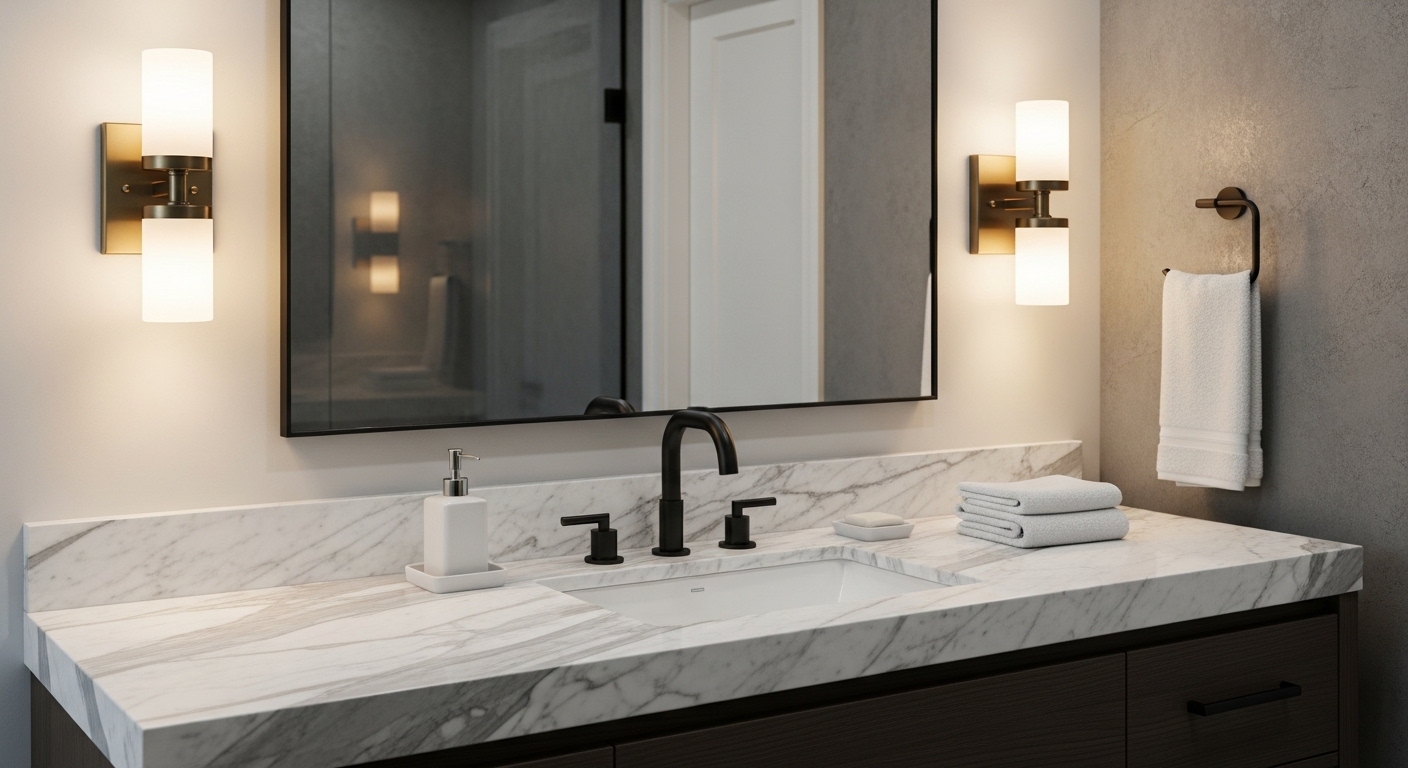
A small puck light with a motion sensor inside the cabinet on the underside of the top, 3000K, $15, so the shelves are visible at 6:30 with the room lights low; a dark cabinet becomes a junk drawer. Beside the mirror, sconces at 63 to 65 inches on each side, at 3000K, which is the argument of the bathroom lighting post and the reason the medicine cabinet is centered with 9 inches of wall each side for the sconces. Cabinets with built-in LED strips around the mirror are sold as the modern option and are mostly 5000K and undimmable; if you want one, check for a warm setting, and if it has none, a plain mirror with two sconces beside it is a better face.
What goes in, and what doesn't
In: toothpaste and brushes, razors, the daily medicine and vitamins, contact lens things, the small tubes and jars, cotton pads, floss, the child's cup. Not in: the hair dryer, which goes in the corner cabinet with its cord; large bottles, which go under the sink; towels, which go on hooks; and anything you use less than weekly, which goes in the over-toilet cabinet. The bathroom storage post is the whole system, and the medicine cabinet is the layer for everything you touch at the mirror.
The frame, and matching the hardware
Thin matte black, to match the faucet and the towel hooks in this bathroom; the same cabinet in brushed nickel in the other bathroom, where the faucet is nickel. The frame is what turns a medicine cabinet from a box into a design: 1 inch wide, matte, in the room's metal. A frameless mirrored cabinet with a beveled edge is the 1990s one, and the difference is $80. The matte black frame is also why the cabinet reads as a choice in a bathroom with white tile and white shaker, where it's the one dark line at eye level and the room needed one.
Small bathrooms and rentals
In a bathroom under 5 feet wide, a recessed cabinet is the best storage per inch in the room, because it takes no depth from the room at all; if the wall over the sink is exterior, a surface-mount with a thin frame sticks out 4 inches and is still better than a mirror with nothing behind it. In a rental, a surface-mount cabinet screws to the wall with four screws where the landlord's mirror hung, and the mirror goes in the closet until you leave; it's the one bathroom upgrade that's fully reversible and fully worth it, and my sister Jen's guest bathroom in Beaverton has the surface-mount we replaced.
Double vanities, and two cabinets versus one wide
Over a double vanity, two recessed cabinets, one centered over each sink in its own stud bay, with a sconce between them and one outside each, which gives each person a door and keeps the sconce geometry from the lighting post. One wide cabinet, 30 to 36 inches, needs a header across cut studs, which is a framing job, or is surface-mounted, and shares the shelves between two people who have opinions about shelves. Two singles cost less than one wide, install on a Saturday, and end the conversation about whose razor is on whose shelf; the wide one looks more like furniture and is the choice when the wall is new construction.
Keeping it organized, which is the point of a door
Three shelves, three jobs: top for the things used weekly, middle for daily at eye level, bottom for the child's cup and the tall bottles. A small tray on the middle shelf for the things that roll. Nothing stacked on anything. Once a season, everything out onto the counter, the expired things binned, the shelves wiped, and back in the same places. A door hides mess but a door on a mess is still a mess when it opens at 6:30, and the season clear-out is what keeps the cabinet from becoming the drawer.
The case for open shelves, for the naturally tidy
If you own three products, live alone or with someone who also owns three products, and enjoy putting the same jar back in the same place every morning, open shelves in a bathroom look wonderful and stay looking wonderful. A single oak shelf beside a round mirror, with a plant and a soap dish, is a lovely thing. I know two people who can live with it. The rest of us have toothpaste.
In one paragraph
A recessed cabinet, 14 to 16 inches wide in a stud bay you've checked, mirror center at 60 to 62 inches, thin frame in the room's metal, mirror on both sides of the door, a light inside, sconces beside. Everything with a label goes in, and the counter stays clear on a Tuesday. Open shelves if you own three things.
Mistakes
The open shelves, for a year. Cutting into the first stud bay before checking it, which found the vent pipe and cost a patch. Buying a 20-inch cabinet for a 14.5-inch bay and returning it. The frameless beveled one in the second bathroom, briefly, before the thin-frame nickel one. And no light inside for the first six months, when the top shelf became a place things were put and not found.
What it cost
The recessed cabinet, 16 by 26, matte black frame, $210. The oscillating tool blade, blocking lumber and screws, $25. The inside puck light, $15. A patch kit for the first bay, $12. About $260 and a Saturday; the surface-mount in the second bathroom was $180 and two hours. The open shelves had cost $90 and looked better in the photo, and the photo is the only place they still look better.
Shop this post: bathroom sconces for either side of the cabinet and bathroom accessories in the same metal as the frame