Battery-operated wall sconces are worth it in exactly one situation: a wall where running a wire would mean opening plaster, and where you need light for a few hours a night rather than all evening. That's our upstairs hallway, which had no fixture at all when we bought the house and a ceiling I wasn't going to cut into, and where a pair of battery sconces has been on the wall for two years and eight months. This is the review after that long, with the numbers: installation, what the light is actually good for, battery life at real use, the switch to rechargeables that fixed the running cost, whether anyone can tell they aren't hardwired (no), the two things I'd change, and where I'd never put one. It's the post I'd have wanted before I bought them, because the product pages say "no wiring needed" and stop there, and the next sentence is the one that matters.
Why battery sconces, and why here
The upstairs hallway in our 1964 ranch is 14 feet long, 38 inches wide, and had one thing on the ceiling: a smoke detector. The previous owners navigated it by the light from the bedrooms. Adding a hardwired sconce meant fishing cable through a wall with no attic access above that part of the house, which the electrician quoted at $480 plus patching, and which would have left the fixture on a switch by the stairs and nowhere else. A pair of battery-operated wall sconces cost $150 for two, went up in 20 minutes with two screws each, and could go wherever I wanted them, which was at 64 inches, staggered, one on each wall, 7 feet apart. The decision was about the wall, not the fixture, and that's the right reason.
Installation: two screws, twenty minutes, one mistake
Each sconce has a backplate with two keyhole slots. Mark the height (64 inches to the center of the fixture, per my placement rules), find a stud or use drywall anchors, two screws, hang the plate, clip the fixture on, drop the batteries in. Done. The one mistake was mounting the first one at 70 inches because the ladder was already there and it felt right from the ladder; it lit the ceiling and I moved it the same day, which is a 10-minute job on a battery sconce and a patch-and-paint job on a hardwired one. The look, once they were up, is identical to hardwired sconces. Guests have stood directly in front of them and not noticed. The battery compartment is inside the shade and the only tell is the tiny switch on the underside.
What the light is good for, and what it isn't
The light is warm and ambient: 2700K, about 150 to 200 lumens each at the "high" setting, which is enough to walk the hallway confidently, find a door handle, and not wake anyone on the way to the bathroom. It is not enough to read by, and it isn't meant to be; a hallway doesn't need reading light, and a bedside does, which is why battery sconces are wrong beside a bed and right in a corridor. At the low setting, about 60 lumens, they're a nightlight with better manners. The light quality is fine, not special: an LED behind a frosted shade, no flicker, slightly cooler than the 2700K claim on the box when the batteries are low, which is the first sign to change them.
Battery life at real use: the number the box doesn't give
The box said "up to 100 hours." At our use, 4 to 5 hours a night on the high setting, on a timer from dusk, the first set of alkaline batteries (three AAs each) lasted 17 weeks, or about four months. That's roughly 500 hours at a mix of high and low, so the box is fair if you use the low setting and optimistic if you don't. Six AAs every four months is about $9 a change and $27 a year, plus the annoyance of finding a stepladder in the dark when they die, which they always did at 9 pm. After the second change I switched to rechargeable NiMH AAs, two sets so one is always charged, $32 for eight plus a charger I already had. They run about 14 weeks per charge, slightly less than alkalines, and the running cost dropped to nothing. That's the setup I'd recommend from day one: rechargeables, two sets, swap on the first Sunday of the month you expect them to die.
Timer and motion: the settings that matter
Ours have a built-in timer (on for 6 hours from when you press it, then off) and a motion mode. The timer mode is the one we use, pressed at dusk by whoever's upstairs, and it's why the battery life is predictable. Motion mode sounds better and drains batteries in three weeks in a hallway a family of three and a cat walk through forty times a day; it's the right mode for a closet or a garage door, and the wrong one for a corridor. If your sconce has neither, a light-sensing switch isn't available on a battery fixture, so you're relying on remembering to turn it off, which is how a set of alkalines lasts eleven days, and how I learned the timer mode existed.
Do they look real?
Yes, from any distance beyond arm's length, and the reason is that they're designed like real sconces, with a metal backplate, an arm and a shade, rather than like the stick-on puck lights that get called "battery sconces" in listings. Choose one with a proper shade, an opal glass or a fabric drum, over one with a visible LED panel, because the panel is the thing that reads as a gadget. Ours are a small black dome on a short arm, and they match the hardwired sconces downstairs closely enough that nobody has asked why the upstairs ones have no switch on the wall. The finish has held: no chipping, no yellowing of the shade after two and a half years, one wipe with a cloth a month, and the cat has not managed to knock one off yet.
What I'd change
Two things. First, I'd buy the rechargeable kind with a USB port in the fixture rather than a battery compartment, which didn't exist in our size and finish when I bought these and does now; a rechargeable sconce with a removable light head charges on a nightstand like a phone and does away with the AA cycle entirely, with a brighter LED and a real dimmer. If I were buying for the hallway today, that's what I'd buy, and it's what my sister got for her stairwell last year on my advice. Second, I'd have mounted them 6 inches lower from the start. Otherwise they've done the job for two years and eight months without a service call, which is more than I can say for the hardwired one in the powder room.
Where battery sconces belong, and where they don't
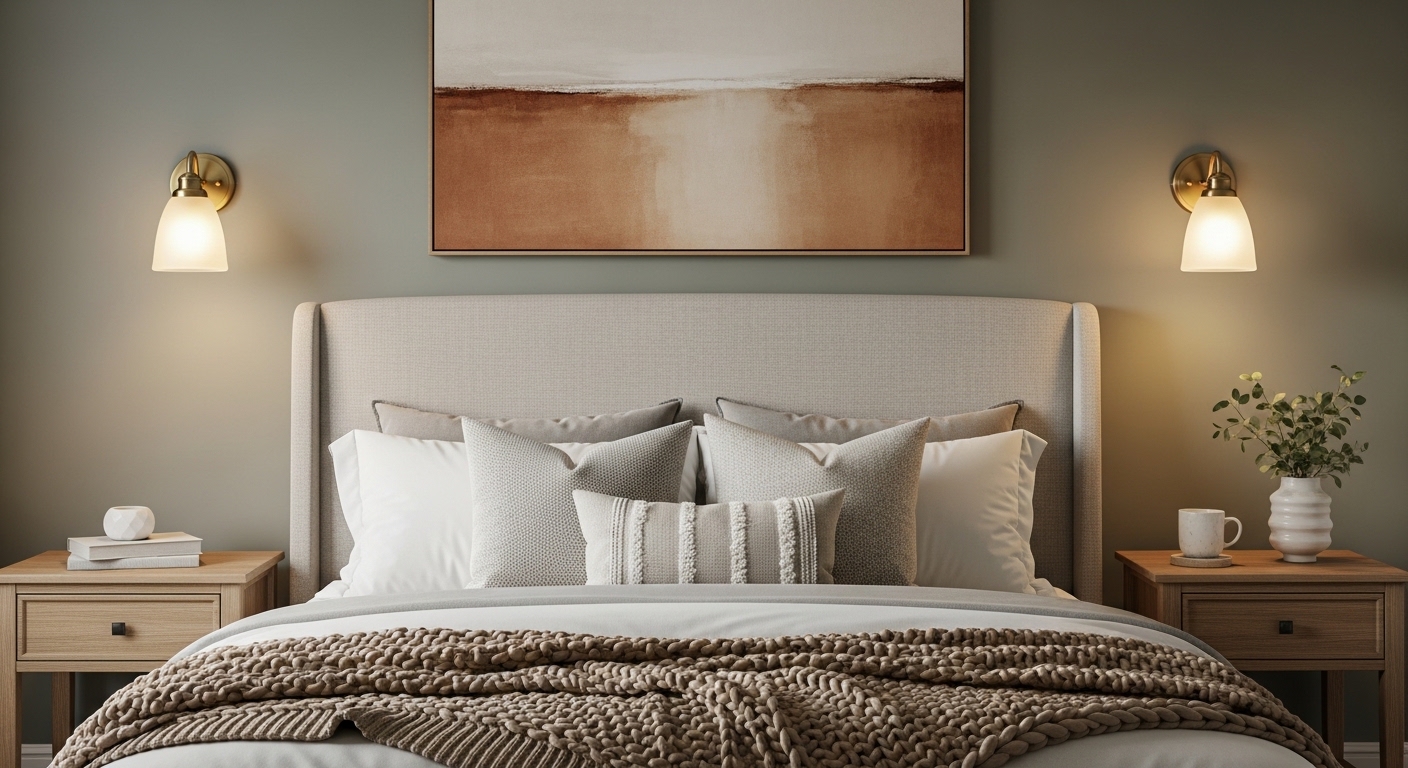
Belong: hallways and stairwells with no wiring, closets, a garage entry, a guest room that needs a nightlight, a rental where nothing can be hardwired or plugged in, a stone or brick wall you can't cut, and anywhere the light is on for a few hours and the alternative is opening a wall. Don't belong: beside a bed, where you want reading brightness and a proper switch; a living room, where they'd be on all evening and the batteries wouldn't last a fortnight; a bathroom mirror, where 200 lumens isn't enough to see your face; and any wall within 6 feet of an outlet, where a plug-in sconce gives you real light with no batteries for the same money. Battery sconces are a solution to a wiring problem, and if you don't have the problem, you don't need the solution.
Battery versus plug-in versus hardwired, in one table's worth of prose
Hardwired: brightest, dimmable from the wall, zero running cost, $150 to $500 to install per pair depending on the wall, and permanent. Plug-in: nearly as bright, dimmable with a plug-in dimmer, zero running cost, needs an outlet within cord reach and a way to hide the cord, $40 to $150 per fixture, movable. Battery: dimmest, timer or motion rather than a real dimmer, $27 a year in alkalines or nothing with rechargeables, needs no wall access at all, $60 to $120 per fixture, movable in a minute. The right answer in most rooms is the plug-in. The right answer for our hallway was battery. The right answer beside the bed was hardwired, and the whole decision is in my bedroom sconce post.
What to look for when buying a battery sconce
A real shade, opal glass or fabric, not an exposed LED panel. A stated color temperature of 2700K or 3000K; anything that says "warm white" without a number is usually 3500K and looks it. A high and a low setting, and a timer mode. AA or AAA batteries rather than a coin cell or a proprietary pack, so rechargeables work. A metal backplate with keyhole slots, not adhesive, because a fixture with batteries in it weighs more than adhesive likes over a year. And a finish that matches your other sconces exactly, black, brass or nickel, since the point is for nobody to notice. Skip anything with a remote control (you will lose it, and the sconce will then be permanently on high), anything "color changing," and anything under $30, which is a puck light with a bracket. $60 to $120 each is where the ones that look like fixtures live.
The maintenance record, in full
Every 14 weeks, swap the rechargeables, which takes two minutes per fixture and involves standing on a stool. Once a month, a wipe with a dry cloth. Once, in two years and eight months, a fixture stopped responding to its switch, which turned out to be a battery that had leaked in the humid week in August; rechargeables don't do that, alkalines do, and it's another argument for the switch. The plastic clip that holds the fixture to the plate has been unclipped about twenty times for battery changes and shows no wear. If it did, the fixture is $75 and the plate stays on the wall. That's the whole maintenance record, and it compares well with the powder room's hardwired sconce, which needed an electrician for a loose neutral last spring.
The stairwell question
The other place people ask about is the stairwell, and it's a harder case than the hallway because a stair needs enough light to see the treads, which is more than 200 lumens if the stair is dark-carpeted, and because the fixtures sit where a hand on the wall can knock them. My sister's stairwell got the rechargeable kind, three of them following the pitch of the stairs at 64 inches above each tread, on the timer, and they're bright enough on high; a battery AA sconce would have been borderline. If the stairwell has a switch at the top and bottom already, wire it and don't think about batteries. If it has nothing, the rechargeable sconce is the answer, and mount them on the side you don't hold the rail.
Would I buy them again?
Yes, for the same wall, and with the rechargeable version. They cost $150, saved $480 of electrical work and a patched ceiling, and have lit a hallway that had never been lit, for about $60 in batteries over nearly three years. Evaluated on outcome rather than intention, which is the only way I know to evaluate anything, they're one of the better purchases in this house. They're also, and I want to be clear about this, the wrong fixture for almost every other wall in it, and the review above is as much about where not to put one as where to.
Shop this post: battery-operated wall sconces, rechargeable wall sconces and plug-in wall sconces