How to make your bed like a hotel comes down to two things that are free and one that isn't: the layering formula, which is fitted sheet, flat sheet folded back, duvet, two rows of pillows and a throw across the foot; the making technique, which is pulling everything taut and folding the corners; and, last and least, the linens. I used to think hotel beds looked better because of the sheets, and I bought expensive ones, and my bed still didn't look like a hotel bed. The linens were a red herring. This post is the formula layer by layer with the sizes, the technique step by step including the hospital corner, the pillow arrangement for a queen and a king, the throw fold that takes fifteen seconds, the duvet versus comforter question, the sheets that matter at the margin and what to spend, the mattress and the topper, what hotels do that you shouldn't, the ninety-second morning version, mistakes, and what the whole thing cost against the sheets I'd bought first.
Why hotel beds look the way they do
Three reasons, in order of importance. The bed is made tight: sheets pulled taut, corners folded, the duvet smoothed and its edge straight, so every surface is a plane rather than a heap. The layers are visible: a band of folded-back sheet, then the duvet, then two heights of pillow, then a throw, so the bed has horizontal lines and depth instead of one lump. And the colors are few: white, or white and one tone, so the lines read. The sheets are usually ordinary hotel-supply percale. A hotel bed is a technique and a formula, and both cost nothing.
The formula, layer by layer
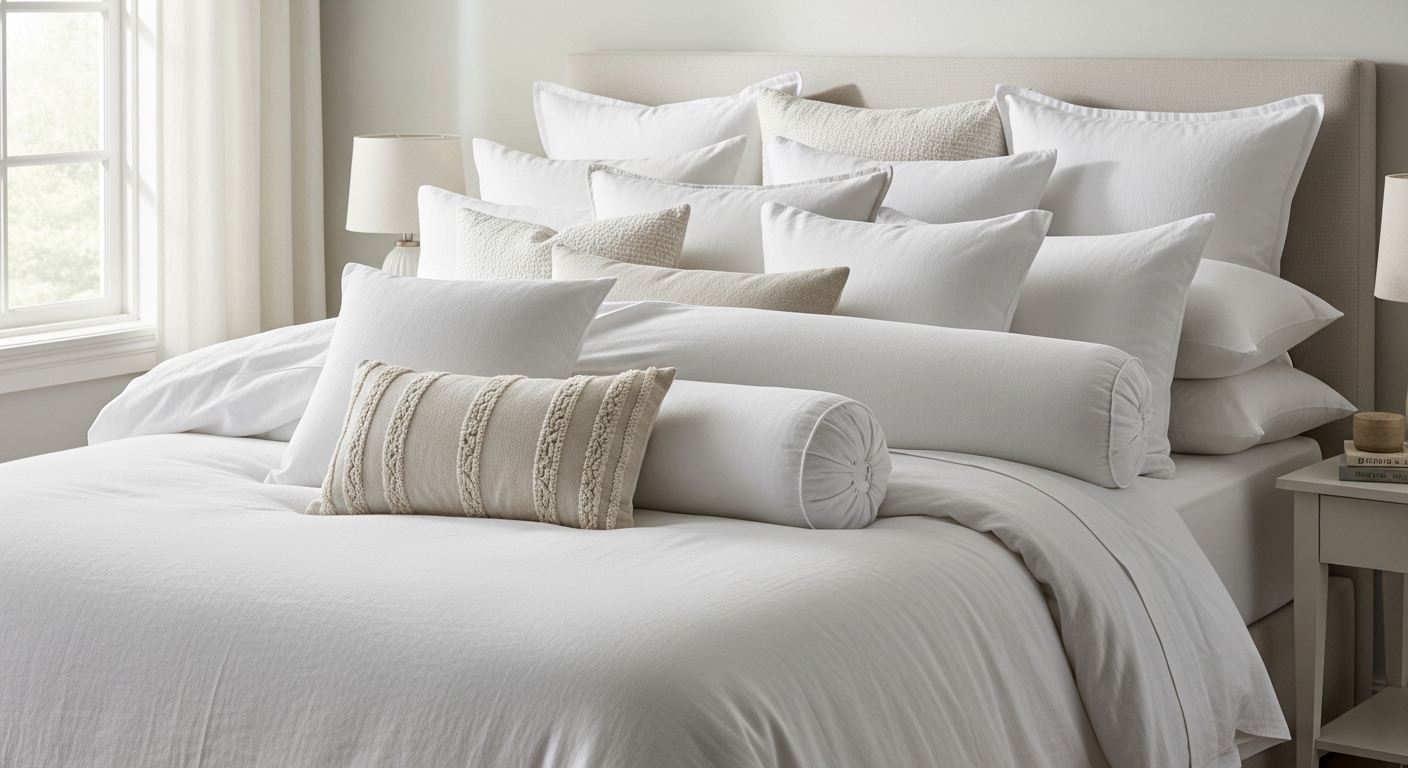
Fitted sheet, pulled tight over the mattress and a topper if there is one. Flat sheet, laid with the top hem at the head of the mattress, tucked at the foot and the sides, then folded back 12 inches at the top so the fold shows as a band. Duvet in a cover, laid so the top edge sits 6 inches below the fold of the sheet, straight and centered, with the sides hanging equally, or, the hotel way, tucked at the foot. Pillows: two sleeping pillows in shams standing at the back, two euro pillows in front for depth, and one or two small accent pillows at the front, in that order and no more. A throw blanket folded in thirds lengthwise, laid across the bottom third of the bed. Six layers, and every one is a horizontal line.
The technique, which is most of it
The fitted sheet goes on tight: pull each corner past the mattress corner and let it grip, then smooth from the center out. The flat sheet: tuck the foot end under the mattress first, deep, then do the hospital corner on each side at the foot, lift the side of the sheet at 45 degrees, tuck the hanging triangle under, drop the fold and tuck it, then tuck the sides. Fold the top back over the duvet's top edge. The duvet: shake it so the insert fills the corners, lay it, smooth from the middle to the sides with flat hands, and straighten the top edge with two hands so it's parallel to the sheet fold. Pillows: chop the tops of the standing ones so they hold, lean the euros. Throw: thirds, then across. The technique is what creates most of the hotel look; better linens help at the margin. Four minutes the first week, ninety seconds by the second.
The hospital corner, slowly
Tuck the foot of the flat sheet under the mattress. Standing at the side near the foot, lift the sheet's edge about 16 inches up from the foot corner and lay it on top of the mattress, so a triangle of sheet hangs down at the corner. Tuck that hanging triangle under the mattress. Drop the lifted edge back down over it, and tuck the whole side under. The corner is now a folded 45-degree seam, and it holds the sheet flat through a night. It sounds fussy and it takes eight seconds per corner once your hands know it, and it's the single thing that separates a made bed from a hotel bed at the foot, which is the end you see from the door.
Pillows: queen and king
Queen: two standard sleeping pillows in shams at the back, two 26-inch euro pillows in front, one 12 by 20 lumbar or two 18-inch squares at the front. King: two king sleeping pillows, three euros to fill the width, one long lumbar. The shams and the euros in the same color as the duvet or one shade off; the accent pillow can be the one color in the bed. Inserts 2 inches larger than the covers so they stand. Sleeping pillows standing, not lying, because standing pillows are a headboard and lying ones are a slept-in bed. At night the euros and the lumbar go to a bench or a chair, which is two moves and the reason the count is five and not nine.
The throw fold
A throw blanket folded at the foot of the bed takes a nicely made bed to a styled one. Fold it in thirds lengthwise so it's a long band about 18 inches wide, and lay it across the bottom third of the bed, edges hanging equally over the sides, or tucked if you like the tight look. Fifteen seconds, and it's the single highest-impact styling move on a bed, because it adds a horizontal line and a texture where there was only duvet. Wool or a heavy knit in a color darker than the duvet, so the line shows.
Duvet or comforter
A duvet with a removable cover, because the cover washes and the look is a smooth plane; a comforter with a printed pattern is a lump with a picture on it and it doesn't wash. The insert should be the bed's size or one up, so it hangs to the mattress bottom on the sides; a queen insert on a queen bed hangs a hand short and reads as too small. White or oatmeal cover, in cotton percale for the crisp hotel look or linen for the rumpled one; hotels use percale because it presses. The duvet is the biggest plane on the bed and the color of the whole thing, and one plain cover is the choice.
The linens, and what actually matters
A good linen or percale duvet set runs $150 to $300, and it's the upgrade I'd make first, after the technique, because the cover is the surface you see; the sheets underneath matter less. What matters in sheets is a tight fitted sheet that grips, a flat sheet big enough to fold back and tuck, and a fabric that holds a plane: percale for crisp, linen for soft, sateen for shiny, and the shiny one is the one hotels don't use because it shows every crease. Thread count is marketing above about 300. The expensive sheets I'd bought first were sateen at 800 count, and they looked like a slept-in bed the moment I sat on it; the $60 percale set looks like a hotel because it's what hotels buy.
The mattress and the topper
Hotel beds feel like hotel beds partly because of a 2-inch topper, feather or foam, under the fitted sheet, which adds the loft that makes the bed look deep and feel soft. $80 to $150, and it's the one thing on this list that changes the feel rather than the look. The fitted sheet has to be deep-pocket to go over it, which is the detail that catches people; a standard fitted sheet over a topper pops off at 3 am.
Color, and the one-tone rule
Hotels use white because white shows the lines and hides nothing, and it's the safest choice at home too: white duvet cover, white sheets, white shams, and one color in the throw and the lumbar. The second-safest is one tone throughout, oatmeal linen or a grey percale, with a darker throw. What breaks the hotel look fastest is pattern, because a pattern hides the horizontal lines that the technique makes, and three colors, because the eye stops counting lines and starts counting colors. One tone, one accent, and the band of folded sheet and the throw are the only two lines you need.
The bed in the room: the headboard, the light and the nightstands
A made bed against a bare wall looks like a bed in a showroom; against a headboard, or a wall with two sconces, it looks like a hotel room. The sconces at 60 inches either side, the wall lamps that replaced the table lamps, are what a hotel bed has that a photograph of one doesn't show, and at 30 percent in the evening they're the reason the bed looks made even when it's only tidy. The nightstands: a lamp-shaped nothing, a glass and a book, and that's the frame around the bed. Nothing under the bed that shows, no basket at the foot but the bench for the pillows.
What hotels do that you shouldn't
Tuck the duvet at the foot so tightly that you can't get in, which is fine for a photograph and a fight for a sleeper. Six pillows on a queen, which is where the pillows go on the floor. A bed skirt, which collects dust and hides storage. And the triangle-fold on the top corner of the duvet, the turned-down invitation, which is for arrival and not for Tuesday. The hotel look at home is the technique and the formula without the theatre.
The ninety-second morning
Pull the duvet up and smooth with one sweep. Fold the sheet band back. Stand the two pillows, chop them. Lean the euros. Center the lumbar. Fold the throw across. Done, and it's the same bed as the four-minute version because the sheets were tucked properly the last time they were changed, and the hospital corners are still holding. The bed gets made properly on sheet-change day, and the other six days are the ninety seconds.
Sheet-change day, which is when the bed gets made properly
Once a week: everything off, the topper straightened, the fitted sheet on tight, the flat sheet tucked with the corners, the duvet cover changed with the inside-out roll trick, the pillows chopped, the throw folded. Eight minutes, and the six days after are ninety seconds each because the foundation holds. Two sets of sheets in rotation and one spare duvet cover, so the change never waits on the laundry, and the laundry room is where the spare set lives folded on the counter.
In one paragraph
Tight fitted sheet, flat sheet tucked with hospital corners and folded back a foot, a plain duvet in a washable cover straight and centered, two standing pillows, two euros, one lumbar, a throw in thirds across the foot. One tone and one accent. Sconces beside. The technique is the look; the sheets are the margin.
Mistakes
The 800-count sateen, $240, which looked slept-in. Nine pillows, for a summer. A queen insert in a queen cover on a queen bed, short on both sides. No throw, for years, which is the fifteen seconds I'd missed. Standing pillows lying down. And thinking the linens were the answer, for about three years, which is the mistake this whole post exists to save you from.
What it cost, against the sheets
The sateen sheets I bought first, $240, and they're in the guest room. The percale sheet set, $60. The linen duvet cover, $180. Two euro inserts and shams, $130. A lumbar, $40. The wool throw, $70. The topper, $110. About $590 for a bed that looks like a hotel every morning in ninety seconds, and the technique, which is most of the look, was free and is in the paragraphs above. The nightstand post is the two surfaces beside it, which are the other half of the photograph and are also mostly subtraction.
Shop this post: bedroom wall lamps, the light that makes a made bed look like a hotel's after dark