Wall sconce height, in one line: the center of the fixture at 60 to 66 inches from the floor in living rooms, hallways and bathrooms, 24 to 30 inches above the mattress beside a bed, and 6 to 8 inches above the edge of a mirror when it has to go above rather than beside. Almost every other placement question, spacing, distance from a corner, how far from a door frame, follows from those numbers and the size of the wall. The most common wall sconce mistake isn't the sconce; it's the height, and the reason is mechanical. When you're on a ladder with a fixture in your hand, the natural tendency is to mount it where it's comfortable to work, which is about 70 inches, not where it will look and function best, which is lower. I have hung eleven sconces in our Portland ranch over six years and moved four of them, so the rules below are the ones that survived being tested against a wall with patched holes in it.
Why the height matters more than the fixture
A sconce is a light source at eye level, and its whole job is to put light on walls and faces from the side, which no ceiling fixture can do. Mount it too high and it becomes a small, expensive ceiling light: it lights the top third of the wall and the ceiling, and the room reads as lit from above again. Mount it too low and it lights the baseboard and the top of the sofa, and the bulb sits in the eyeline of anyone seated. Eye height for a standing adult is around 60 to 66 inches, and that's the target because a sconce at that height lights the part of the wall you actually look at and the faces of people standing near it. In a room where people mostly sit, the target drops a few inches. That's the principle. The rest is arithmetic.
Living room and hallway: 60 to 66 inches
Center of the fixture, meaning the middle of the light source, not the top of the backplate, at 60 to 66 inches from the finished floor. I use 64 in our hallway, where the ceiling is 8 feet, and 62 in the living room, where the sconces flank a sofa and people are seated most of the time. If the sconce has a shade that projects light down, mount at the top of the range so the light lands on the wall; if it's an uplight with a bowl or a half-moon shade, mount at the bottom of the range so the wash up the wall is long. In a hallway, one sconce every 6 to 8 feet on one wall, staggered if they're on both, and never one directly opposite another, which makes a corridor feel like an airport. The living room pair I wrote about in my living room sconce post are 62 inches high and 7 feet apart, either side of a 78-inch sofa.
Beside the bed: 24 to 30 inches above the mattress
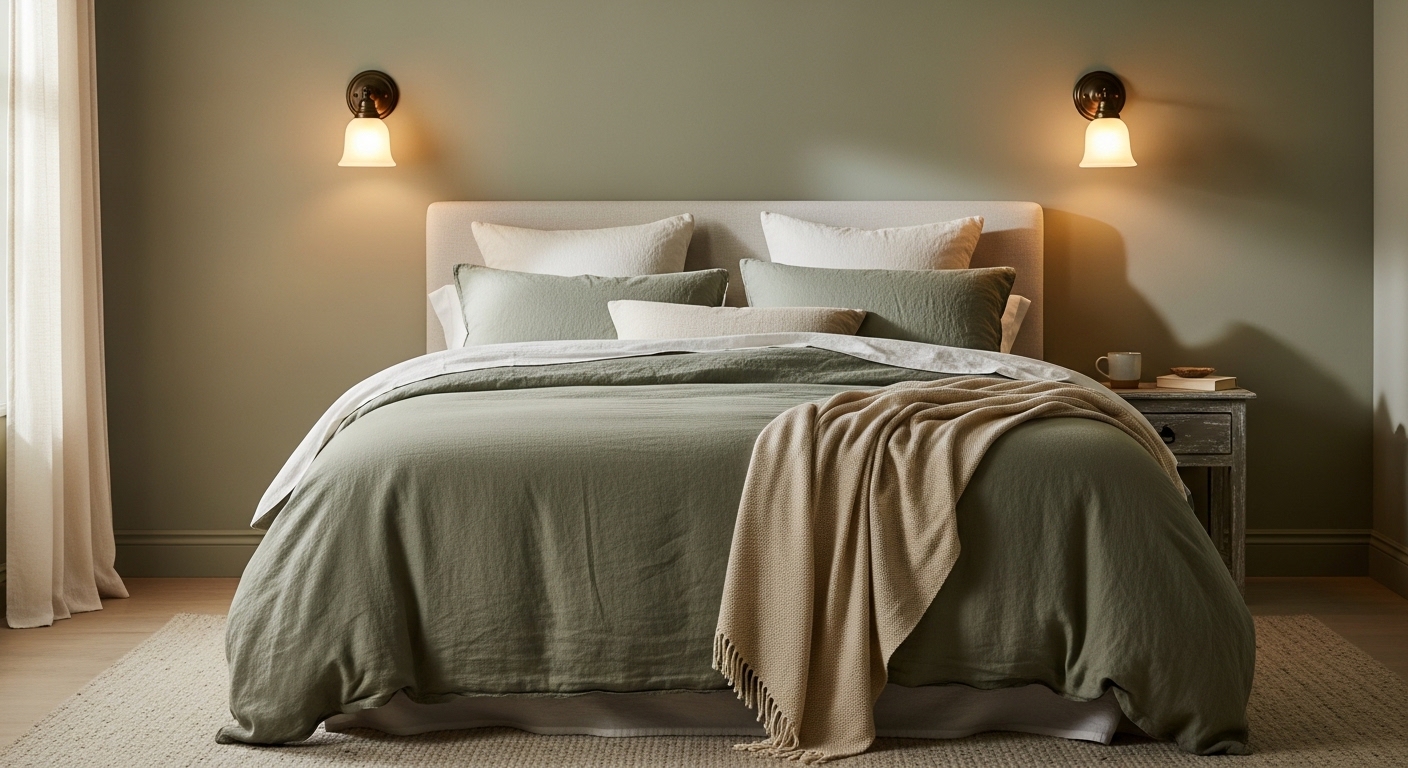
This is the one place the floor measurement doesn't help, because beds vary by a foot in height. Measure from the top of the mattress: the center of the sconce 24 to 30 inches above it, which lands somewhere around 50 to 56 inches from the floor for a typical bed. Lower in the range for a sconce you read by, higher for a swing-arm or an uplight. Horizontally, center it over the nightstand, or 6 to 8 inches outside the edge of the headboard if there's no nightstand, and never directly over the mattress edge, where it lights the pillow instead of the page. If the sconce is a reading light with an adjustable arm, the pivot point should be at shoulder height when you're sitting up against the headboard. Ours, from the bedroom sconce decision, are at 27 inches above the mattress and centered on the nightstands, and they're the fixtures I'd save in a fire.
Bathroom: beside the mirror, at 60 to 65 inches
Sides, not above. Center of the light at 60 to 65 inches, or eye height, and spaced just outside the mirror's edges, 28 to 36 inches apart for a mirror up to 36 inches wide. Side-mounted sconces at face level light the face evenly from both directions; a fixture above the mirror lights the forehead and shadows the eyes, which is the whole story of my bathroom lighting mistake. If the only box is above the mirror, mount the fixture so its bottom edge is 6 to 8 inches above the mirror's top edge and choose one with shades that face out, not down. For a double vanity, one at each end and one between the mirrors, same height.
Spacing between sconces, and distance from corners and doors
Two sconces flanking something, a sofa, a fireplace, a console, a mirror, sit 6 to 12 inches outside the edges of the thing, so a 60-inch console gets sconces 72 to 84 inches apart. Sconces along a plain wall sit 6 to 8 feet apart. From an inside corner, at least 12 inches to the center of the fixture, or the shade throws a hot spot into the corner. From a door frame, at least 8 inches, and on the latch side if you have the choice, so the door doesn't swing into it. From a window frame, 6 to 10 inches, with the sconce at the same height as the top of the window trim if that's within the 60-to-66 range, because the eye likes the lines to agree. Every one of these numbers I got wrong once; the corner one I got wrong twice, in the same corner, which my husband has not let me forget.
Ceiling height changes the numbers
The 60-to-66 rule assumes 8-to-9-foot ceilings, which is what a ranch house has. With 10-foot ceilings, raise the range by 4 to 6 inches, so the sconce sits at about the same proportion of the wall, and choose a taller fixture so it doesn't look lost. With 12-foot ceilings, 70 to 72 inches and a fixture at least 16 inches tall. In a stairwell, the height is measured from each tread, 60 to 66 inches from the nose of the step directly below the fixture, and the sconces follow the pitch of the stairs in a line, which means each one is a different height from the hall floor and the same height from the step, and that's correct even though it looks wrong on the plan. Sloped ceilings in a converted attic: measure from the floor, ignore the ceiling, and keep the sconce on the wall that's vertical.
Pairs, symmetry and the one time to break it
Sconces come in pairs for a reason: one sconce on a wall looks like a mistake unless it's clearly a task light, beside a desk or a bed. A pair should be at exactly the same height, which means measuring both from the floor, not eyeballing the second one against the first from across the room, which is how I ended up with a half-inch difference that I saw every day for a year. The one place I break symmetry is a hallway with doors on one side, where the sconces go on the blank wall opposite, staggered to the door frames. Odd numbers along a long wall are fine; three sconces 7 feet apart reads as a rhythm. Two on a long wall reads as a gap, and the eye keeps looking for the third.
Plug-in sconces: same heights, plus a cord to plan
A plug-in sconce goes at exactly the same heights; the only difference is that the cord has to reach an outlet, which is usually 12 to 18 inches off the floor, and it has to get there in a straight line down the wall, inside a paintable cord cover or behind a piece of furniture. Plan the horizontal position around the outlet first, then check it against the spacing rules. In our daughter's room the outlet dictated a sconce 4 inches further from the headboard than I'd have chosen, and the cover painted to match the wall made the cord invisible, so the compromise was worth it. Battery and rechargeable sconces, which have no cord at all, are in my battery sconce review, and they go where any sconce goes.
Entryway, dining room, kitchen and outdoors
Entryway: 60 to 66 inches, flanking a console or a mirror, and at least 12 inches from the door frame on the latch side; if the entry is a narrow hall, one sconce on the wall you face when you walk in, not beside the door you came through. The pendant-plus-sconce formula for our entry is in the entryway lighting post. Dining room: sconces sit lower than anywhere else in the house, 58 to 62 inches, because everyone is seated and a fixture at standing eye height puts the bulb in the sightline across the table; they flank a sideboard or a piece of art, never the window. Kitchen: sconces above open shelving go 12 to 18 inches above the top shelf; beside a range hood, 66 inches and at least 12 inches from the hood's edge; over a sink with no window, one sconce centered above at 72 inches. Outdoors: the center of a porch or entry sconce at 66 inches, or roughly at the height of the door handle plus 24 inches, and 6 to 12 inches from the door trim, with a matching pair if the door is centered and a single one on the latch side if it isn't. Garage and side doors take the same numbers, and a motion sensor.
Sizing the fixture to the wall
Height is the main rule; size is the second. A sconce's height in inches should be roughly a tenth of the wall's height in inches beside a door or on a large wall, so an 8-foot wall takes a 9-to-12-inch sconce, and a small sconce on a big blank wall looks like a doorbell. Beside a bathroom mirror, the sconce should be shorter than the mirror and no wider than 6 inches, so it doesn't compete. Beside a bed, the shade should be smaller than the nightstand's width. Projection, the distance the fixture sticks out from the wall, matters in a hallway: keep it under 4 inches in any passage narrower than 42 inches, or it becomes the thing everyone's shoulder finds.
The measuring method that stopped me moving fixtures
Painter's tape. Cut a piece the size of the backplate, stick it to the wall at the intended height, and live with it for two days. Stand where you'll stand, sit where you'll sit, look at it from the doorway. Then hold the actual fixture against the tape, because the shade changes where the light will land, and mark the mounting holes through the tape with a pencil. Only then drill, and if it's a hardwired box, only then call the electrician, with the tape still on the wall so nothing gets lost in translation. This takes five minutes and about $3 of tape, and it would have saved me four patched holes and a Saturday, which is the kind of return I used to put in a project status report and now just put in a blog.
Can you mix sconce styles in a house?
Yes, within a finish. We have five different sconce designs in this house and two finishes, brass in the bedrooms and living room, matte black in the kitchen and bathrooms, and the rooms read as belonging to one house because the heights agree and the finishes agree, not because the fixtures match. The rule from my finish post is three finishes maximum across a house; the rule from this one is that a sconce at the wrong height in the right finish looks worse than the right height in the wrong finish. Height first. Always.
Shop this post: best-selling wall sconces, bathroom sconces and plug-in wall sconces