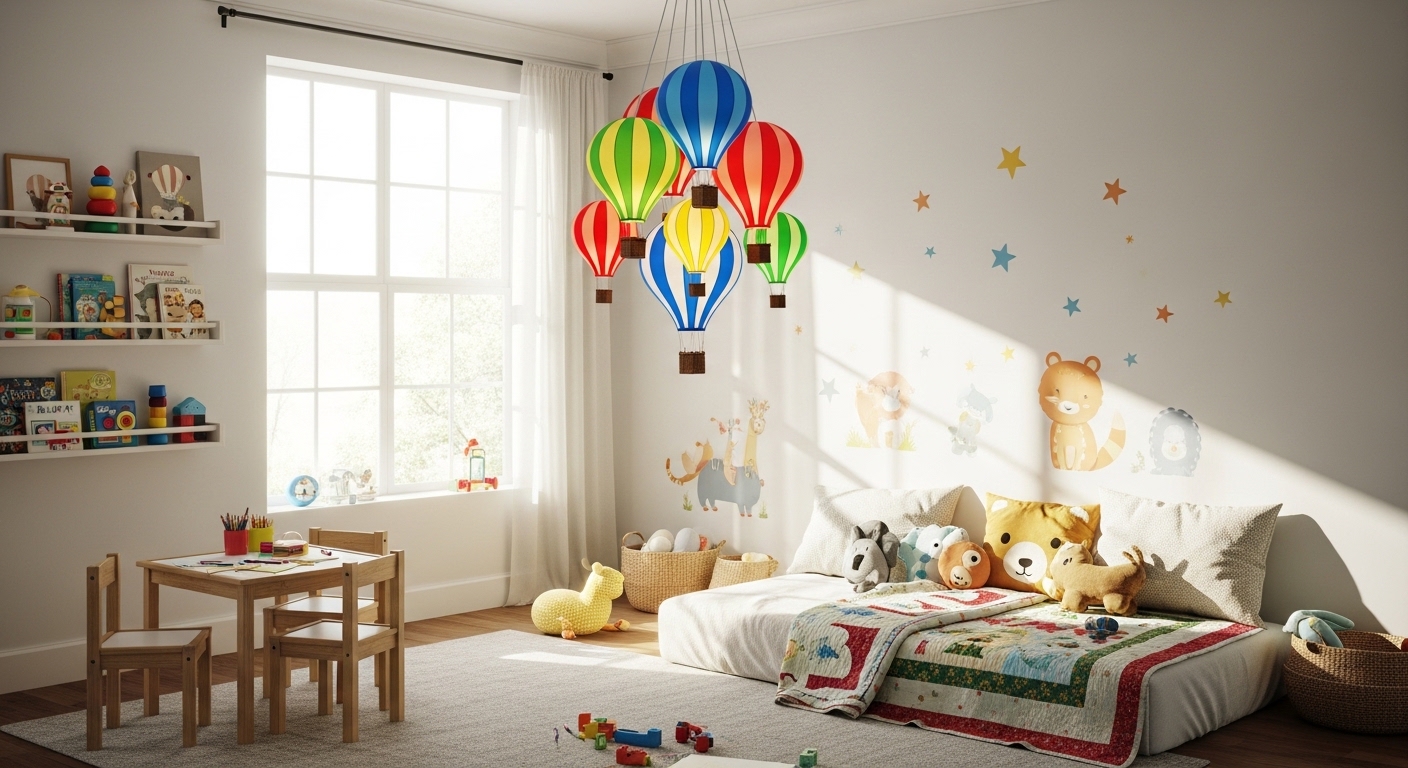
Kids' room lighting that works at every age has three parts and one rule: a ceiling fixture on a dimmer that goes from homework-bright to bedtime-glow, a bedside reading light the child can position and switch herself, and a night light that's warm and low and not a toy; the rule is that nothing character-themed goes in unless it can be removed without repainting, because a fixture bought for a five-year-old is replaced at seven and the one bought for a nine-year-old is still there at fifteen. My daughter is nine, and her room's lighting has been through the toddler version, the little-kid version and the current one, and the current one is the one I'd have started with. This post is the rule and why, the ceiling fixture and the dimmer settings for homework, reading and bed, the clip-on reading light and why not a fixed lamp, the night light and its temperature, the desk light for homework, the closet, the switch heights, what changes from three to eight to twelve, the fixture I almost bought, bulbs and lumens for a child's room, safety and cords, the rental version, mistakes, and what it cost against the one I'd have replaced.
The rule: nothing that needs repainting to remove
Not because I'm a joyless parent, but because I've seen too many rooms that had to be completely redone at seven when the princess ceiling light and the matching wallpaper became mortifying overnight. Fixtures, paint and furniture are the expensive layer and they should be neutral and last a decade; the character layer, the bedding, the posters, the lamp shade, the rug, is cheap and changes every two years without a ladder. A ceiling light with a subtle pattern reads as playful to a nine-year-old and just interesting to a teenager, and it's the one she'll keep until she picks her own fixtures.
The ceiling fixture, on a dimmer
A simple flush mount, 14 inches, white with a faint geometric pattern in the shade, from the ceiling lights, with an 800-lumen 2700K bulb, on a wall dimmer. Homework at full: a child's room is the one place a ceiling light is right at full, because homework happens at a desk under it and the desk light adds to it. Wind-down reading at half: the room warm, the bed lit enough for the reading light to be the point. Bedtime at a warm glow, 15 percent, for the ten minutes of the last story and the drink of water. The dimmer is the whole system; without it the room has one mode, and a nine-year-old's evening has three.
The bedside reading light: a clip-on, not a lamp
A clip-on LED reading light on the headboard rather than a fixed lamp on the nightstand, because she reads sitting up, lying down, on her side and once upside down, and the light needs to go where the book is, which changes constantly. A gooseneck clip with a 2700K bulb, a touch dimmer on the head, and a USB cord to the outlet behind the bed; $18. It's the light she controls, which is the point: a child who can turn her own reading light off from the pillow reads more and calls out less. A fixed sconce at 60 inches is the adult answer and is right at twelve; at nine the clip-on wins because it moves.
The night light
Warm, low and not a toy: a plug-in night light at 2400K with a light sensor, in the outlet by the door, at about 10 lumens, which is enough to find the door and not enough to read by. Not the projector, not the color-changing one, not the character one, all of which we've owned and all of which became either a toy she played with at 11 pm or a light too bright to sleep under. A night light's job is the door and the hall, and the hall's own night light, a motion sensor one at 2400K, takes over at the bathroom.
The desk light
A small task lamp with an arm, 3000K, 450 lumens, on the desk against the wall, on its own switch, for homework; the one light in the room cooler than 2700K, because homework wants a whiter page and the ceiling at full plus the desk lamp is the homework setting. Off at bedtime, always, because a 3000K desk lamp left on is a room that says "still working." The desk faces the wall, the window to the side, and the lamp on the side opposite her writing hand, which is the same rule as the office and which nobody told me applied to a nine-year-old until she complained about the shadow.
The closet, and the switch heights
A stick-on motion sensor light on the closet shelf at 3000K, so she can find the blue shirt without turning on the ceiling at 6:45 am. The room's dimmer at 36 inches on the wall by the door, lower than the 42 that adults get, so she's been able to reach it since five; the reading light's switch on the light; the night light automatic. A child's room where the child can reach every switch is a room where the child turns her own lights off, which at nine is most of the discipline.
What changes: three, eight, twelve
At three: the ceiling on the dimmer at a glow for the whole evening, the night light, and a lamp on the dresser out of reach; no bedside light, because a three-year-old and a cord are a problem. At eight, which is where we are: the dimmer's three settings, the clip-on she controls, the desk lamp for the first real homework, the night light fading out of use. At twelve, which is next: the clip-on becomes a wall sconce at 60 inches with a switch on it, the desk lamp gets bigger, the night light goes, and the ceiling fixture stays because it was chosen not to date. The fixture on the ceiling is the only constant, which is why it was the one to get right.
The fixture I almost bought
The character one, $40 less, a ceiling light with a cartoon on the shade that she loved at the store and that would have been replaced in three years for $110 plus an electrician's visit. The one I chose was $110 and will probably stay until she picks her own as a teenager, so it's the cheaper fixture over ten years by about $150, and it's the one she doesn't notice, which for a ceiling light in a room that changes every two years is the goal.
Bulbs and lumens for a child's room
2700K in the ceiling and the reading light, 3000K at the desk, 2400K in the night light, CRI 90 so the drawings look like their colors. 800 lumens in the ceiling, which at full is enough for a 10 by 11 room's homework and at 15 percent is a glow; 200 in the clip-on; 450 at the desk; 10 in the night light. Nothing above 3000K in a child's bedroom, because the "daylight" bulbs in the kids' section are a wake-up call at 8 pm, and nothing that flashes or changes color as a feature, because a light that's a toy is a toy.
Safety and cords
The clip-on's USB cord runs behind the headboard and is tied off, and it's the only cord within reach of the bed. The desk lamp's cord goes straight to the outlet behind the desk. No floor lamps, which tip, and no table lamp on the nightstand, which a nine-year-old knocks off reaching for water, which is the adult problem in a smaller room. Outlet covers on the unused ones, the night light in the one by the door, and the ceiling fixture the one light that's out of reach, which is why it's the one on the dimmer she can reach.
Screens, and the light at bedtime
The tablet is the brightest light in most children's rooms after eight and the one that undoes the dimmer; ours charges in the kitchen from seven. With the room at 15 percent and the clip-on at its lowest for the last chapter, the last light she sees is 2700K and dim, and the wake-ups at 2 am that the projector night light used to cause have stopped. The lighting in a child's room is half fixtures and half what's not in it, and the tablet is the half that costs nothing to fix.
The rental version
A 2700K bulb in the landlord's ceiling fixture and a plug-in dimmer if the fixture is a lamp, or a smart bulb in it with the three settings if it isn't; the clip-on, which is a rental fixture by nature; the night light; a desk lamp. About $60 and no holes, and it's the same three settings. The ceiling fixture is the only part of this post that costs anything, and in a rental it's a bulb.
The shared room and the bunk bed
Two children in one room need two reading lights, one per bed, each with its own switch and each shaded so it doesn't reach the other bed; the clip-ons do this, and a wall sconce per bed does it at twelve. Bunks take a clip-on per bunk, the top one at the head where the ceiling is close, and the ceiling fixture on the dimmer stays the shared light. The night light goes by the door for both. My sister Jen's two share, and the rule that ended the arguments was a light each with a switch each, which is the same rule as a shared adult bed with different bedtimes.
The morning, since the lights are for that too
A child's room at 6:45 on a school day wants the ceiling at half, not full, and then the closet light doing the clothes; the full setting is for homework and for finding the shoe under the bed. The dimmer she can reach means she brings it up herself, and the difference between a room that starts at 15 percent and rises and one that snaps on at full is a nine-year-old who's awake versus one who's furious. The window's blind goes up first, the dimmer second, and in a Portland winter the dimmer does most of the morning until March.
The desk lamp's second job, and the sconce that's coming
The desk lamp at 3000K is also the light for the craft table, the science project and the puzzle, which happen at the desk because that's where the good light is, and a good desk light in a child's room moves the messy projects off the floor. The sconce that replaces the clip-on at twelve will go at 60 inches beside the bed with a switch on the fixture, in the same finish as the ceiling light, and it's the one purchase in the room's next five years; the placement rules apply to a twelve-year-old's bed exactly as to ours, with the mattress a little lower.
Mistakes
The projector night light, which was a planetarium at 11 pm. A fixed nightstand lamp at six, knocked over weekly. The character fixture in her first room at three, which I did buy and did replace, which is where the rule came from. A daylight bulb in the desk lamp for a month, a wired child at 8 pm. And a dimmer at 42 inches that she couldn't reach until seven, which meant I turned her light off for two years I didn't need to.
In one paragraph
A plain ceiling fixture on a dimmer the child can reach, a clip-on reading light she controls, a warm night light by the door, a 3000K desk lamp on its own switch, nothing character-themed on the ceiling, and nothing over 3000K anywhere. Three settings, three ages, one fixture that lasts.
What it cost, against the one I'd have replaced
The flush mount, $110. The dimmer, $25. The clip-on reading light, $18. The night light, $12. The desk lamp, $40. The closet sensor light, $15. Bulbs, $16. About $236 for a room's lighting that will last until she's fifteen, against $70 for the character fixture and a night light that would have been $250 again at seven. The room changes every two years in bedding and posters, and the light doesn't, which is the only way I know to keep up.
Shop this post: ceiling lights that won't date and bedroom wall lights for the sconce at twelve