Our bathroom remodel cost $16,400 against an $8,000 budget, took six weeks against a scheduled three, and the reasons were ordinary: wet plaster behind the shower tile that nobody could see until the tile came off, a vanity ordered after demolition with a seven-week lead time, and sconces that were discontinued between ordering and installing. That's a 5 by 9 main bathroom in a 1964 Portland ranch, full gut, mid-range fixtures, done by a contractor with me as the project manager, in 2024. If you're planning one, the number to carry is this: budget 20 percent above the highest quote you get, choose every fixture before the first tile comes off, and order the lighting first even though it goes in last. This post is the full accounting line by line, where the extra $8,400 went, what a bathroom remodel costs at three levels from what I've seen since, the timeline and why it doubles, the order to make decisions in, the vanity as the decision that sets every other one, the things I'd change, the things I'd keep, what a contractor does that you can't, what you can do yourself, and whether I'd do it again.
What we spent, line by line
Demolition and disposal, $900. Plumbing, including moving the drain 6 inches for the new vanity and replacing the shower valve, $2,400. The plaster surprise behind the shower, full replacement with cement board, $2,100. Electrical, two new boxes for the sconces, a GFCI outlet and an exhaust fan on a timer, $1,300. Tile, floor and shower, materials and labor, $3,600. The vanity with the top and sink, $1,450. The faucet and shower fixtures, $620. The toilet, $380. The sconces and the ceiling light, $340. The mirror, medicine cabinet and hardware, $460. Paint and trim, $350. Contractor's management and the things that don't fit a line, $2,500. Total, $16,400, and the budget of $8,000 had been built from a spreadsheet of fixture prices with a guess for labor, which is how most first budgets are built and why they're wrong by half.
Where the extra $8,400 went
The plaster, $2,100, which existed invisibly until the tile came off; this is not unusual, and every contractor I've spoken to since says a bathroom in a house over fifty years old hides something behind the shower wall in most cases. The vanity delay, which added three weeks of a plumber's return visits and the contractor's time, about $1,100. The moved drain, $600, because the vanity I loved had its plumbing in a different place from the one I'd budgeted around. The fan and the GFCI, $700, which weren't in the budget because I didn't know they were required by code when you open the wall. And labor generally, about $3,900 more than my guess, because my guess had been a number I wanted rather than a quote I'd got.
What a bathroom remodel costs, at three levels
From our project and the five friends' bathrooms I've project-managed or advised since, all in the Portland area between 2023 and 2026, for a 40 to 50 square foot full bathroom: a cosmetic refresh, keeping the layout and the tile, new vanity, faucet, toilet, lighting, mirror and paint, runs $4,000 to $7,000 with a handyman and $2,500 if you do it yourself. A mid-range full remodel like ours, new tile, new fixtures, same layout, a contractor, runs $14,000 to $22,000. A high-end remodel with a moved layout, custom tile, a frameless glass shower and stone, runs $30,000 to $50,000 and up. National averages published by the remodeling magazines land in the same ranges, a little lower in most of the country than Portland. The cosmetic level is the one most people should do and don't; the mid-range is the one people budget for the cosmetic price.
The timeline, and why three weeks became six
Week one: demolition, and the plaster found on day two. Week two: waiting for cement board and the plumber's return, and the vanity ordered. Week three: rough plumbing and electrical, inspection. Week four: tile, which is the slow, skilled week. Week five: waiting for the vanity. Week six: vanity, fixtures, lights, paint, done. Three of the six weeks were waiting, and all three were avoidable with fixtures chosen and ordered before demolition. A bathroom remodel's schedule is a chain of trades, plumber then electrician then tiler then plumber again, and one late delivery stalls every trade behind it.
Lesson one: budget 20 percent above your number
Above the highest quote, not above your hope. Our highest quote was $11,000 and we'd have been close with 20 percent on top and the plaster; instead the budget was built from a wish. Hold the 20 percent in an account you don't touch until the tile is off, because the surprise is behind the tile in almost every old bathroom, and if there's no surprise you've got a better faucet.
Lesson two: choose fixtures before demolition starts
Lead times on vanities and bathroom faucets run six to ten weeks for anything that isn't in stock at a big-box store. I chose our vanity after demolition, and the choice delayed the project by three weeks and moved the drain. Choose the vanity, the faucet, the toilet, the tile, the shower fixtures, the lights, the mirror and the hardware, and have them in the garage before the first hammer. A contractor will tell you this; I heard it as advice rather than a rule.
Lesson three: lighting is installed last but ordered first
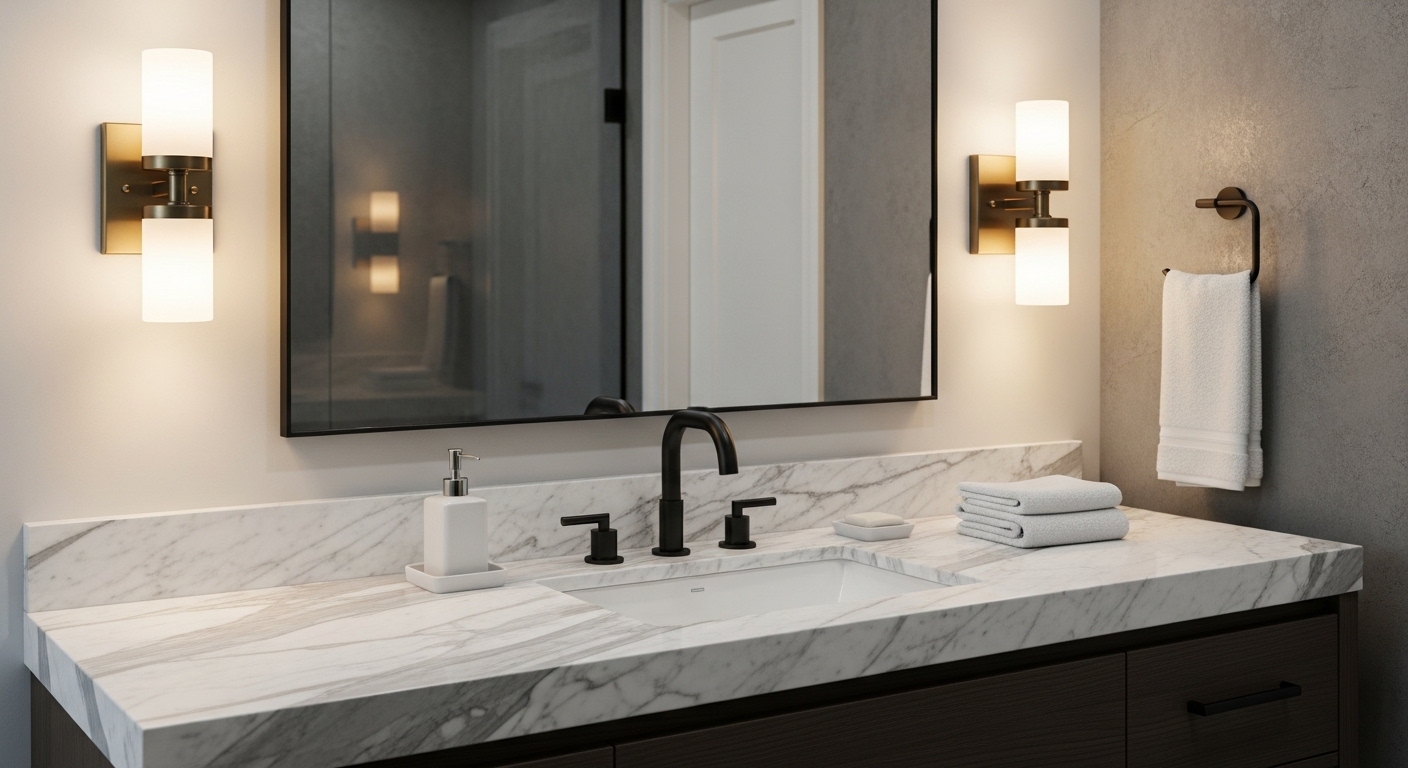
The bathroom sconces I chose were discontinued between ordering and installing, and the replacements were a different size, and the electrician had already placed the boxes for the first ones. Order the lights the day you decide on them and hold them; they're small boxes and they wait well. The sconces go either side of the mirror at 63 to 65 inches, which is a decision that has to be made before the electrician runs the wire, and the bathroom lighting post is why side sconces and not a bar above.
Lesson four: the vanity determines everything
The vanity sets the finish palette for the faucet, the mirror, the hardware and the lights, and it sets where the plumbing goes. Pick it first, then match everything to it, in that order, and buy it before demolition so the plumber knows where the drain is going. Ours is white shaker with a quartz top and a brushed nickel faucet, and the sconces, the medicine cabinet frame and the hooks followed it; the vanity mistakes post is the five things I got wrong on the way to choosing it, including buying before measuring the rough-in.
Where the money goes, as percentages
For a mid-range remodel, from ours and the five since: labor is about half, and the trades split roughly a third plumbing, a third tile, a third electrical and general. Fixtures and finishes are the other half, and within that the vanity and its top are the biggest single line, the tile the second, the shower fixtures the third. Lighting is under 5 percent of the total and changes the room more than the tile does per dollar, which is the argument for spending $340 on sconces instead of $120 on a bar. The number people underestimate is labor, always, by about half; the number they overestimate is fixtures, because the fixture prices are the only ones they can look up.
Ways to keep a remodel under $10,000
Keep the layout, because moving a toilet or a drain is $1,500 before anything else happens. Keep the tub if it's cast iron and sound, and reglaze it for $500 instead of replacing for $2,000 with demolition. Tile the shower and not the whole room, with a porcelain plank floor at $4 a foot. Buy the vanity in stock rather than special order, and buy it before demolition. Do the demolition, the paint and the hardware yourself. Skip the niche, the heated floor and the frameless glass, and use a good curtain. Order the sconces and the faucet online and hold them. Four of the five friends' bathrooms came in between $8,000 and $11,000 this way, and the fifth moved the toilet and didn't.
What I'd change
The order of decisions, above all. A vanity with drawers instead of doors, because the under-sink cabinet became a black hole and the storage post is the fix. A niche in the shower wall, which I asked for after the cement board was up and which would have been $150 before. A larger-format floor tile with fewer grout lines, because grout in a bathroom is the thing that ages. And a heated floor, $600 for a small bathroom, which everyone who has one says is the best money in the room and which I skipped to save $600 in a project that went $8,400 over.
What I'd keep
The side sconces, which changed the mirror. The recessed medicine cabinet. The white shaker vanity, which is the thing everyone says looks expensive. The matte-finish porcelain floor tile, which hides water spots. The exhaust fan on a timer, which I resented paying for and which is why the bathroom has no mildew two years on. And the contractor, who found the plaster on day two and told me the truth about the schedule on day three.
What a contractor does that you can't, and what you can do
A contractor sequences the trades, pulls the permit, knows the inspector, finds the plaster and knows what to do about it, and carries the schedule when a delivery slips. That's the $2,500 management line and it was worth it. What you can do yourself on a mid-range remodel to save real money: demolition, about $900 if you're willing to carry a cast-iron tub to a dumpster; painting, $350; the hardware, mirror and accessories, $200 of labor; and the project management, which is choosing and ordering everything early, which is free and which I did badly the first time and well for the five friends since. Tile, plumbing and electrical are the three you hire, and the tile is the one people think they can do and regret.
Living without the bathroom for six weeks
We have one and a half bathrooms, and for six weeks the half did everything with a gym membership doing the showers, which is the part of a remodel nobody budgets and everybody should: $90 of gym for six weeks and a lot of driving. If it's your only full bathroom, the schedule matters more than the cost, and the fixtures-before-demolition rule is the difference between three weeks of showering elsewhere and six.
The permit and the inspection
A full remodel that opens walls and moves plumbing needs a permit in Portland, about $400 with the inspections, and the contractor pulled it. The inspection is why the fan and the GFCI appeared in the budget, and it's why the bathroom is safe; a cosmetic refresh that swaps fixtures in place doesn't need one. The friend who skipped the permit to save $400 discovered it when she sold the house, and it cost more than $400 then.
The decision order, on one card
Vanity first. Then faucet, toilet and shower fixtures to match it. Then tile, floor and shower. Then lights, mirror and medicine cabinet, ordered the same week. Then hardware and paint. Then the contractor's quote against the list, plus 20 percent. Then everything in the garage. Then demolition. I keep this on a card and I've given it to five people, and the one who skipped the first line moved a drain.
Would I do it again?
Yes. But I'd approach it as a $20,000 project from the start, with every fixture in the garage before demolition and the lights ordered first, and I'd expect six weeks and be pleased with five. The bathroom is the room in the house I'm proudest of, and it cost twice what I planned because I planned with a wish instead of a quote. The five bathrooms I've helped with since have come in within 10 percent, and every one of them started with a vanity in a garage and a 20 percent line nobody was allowed to touch.
Shop this post: bathroom sconces and bathroom faucets, ordered early and held