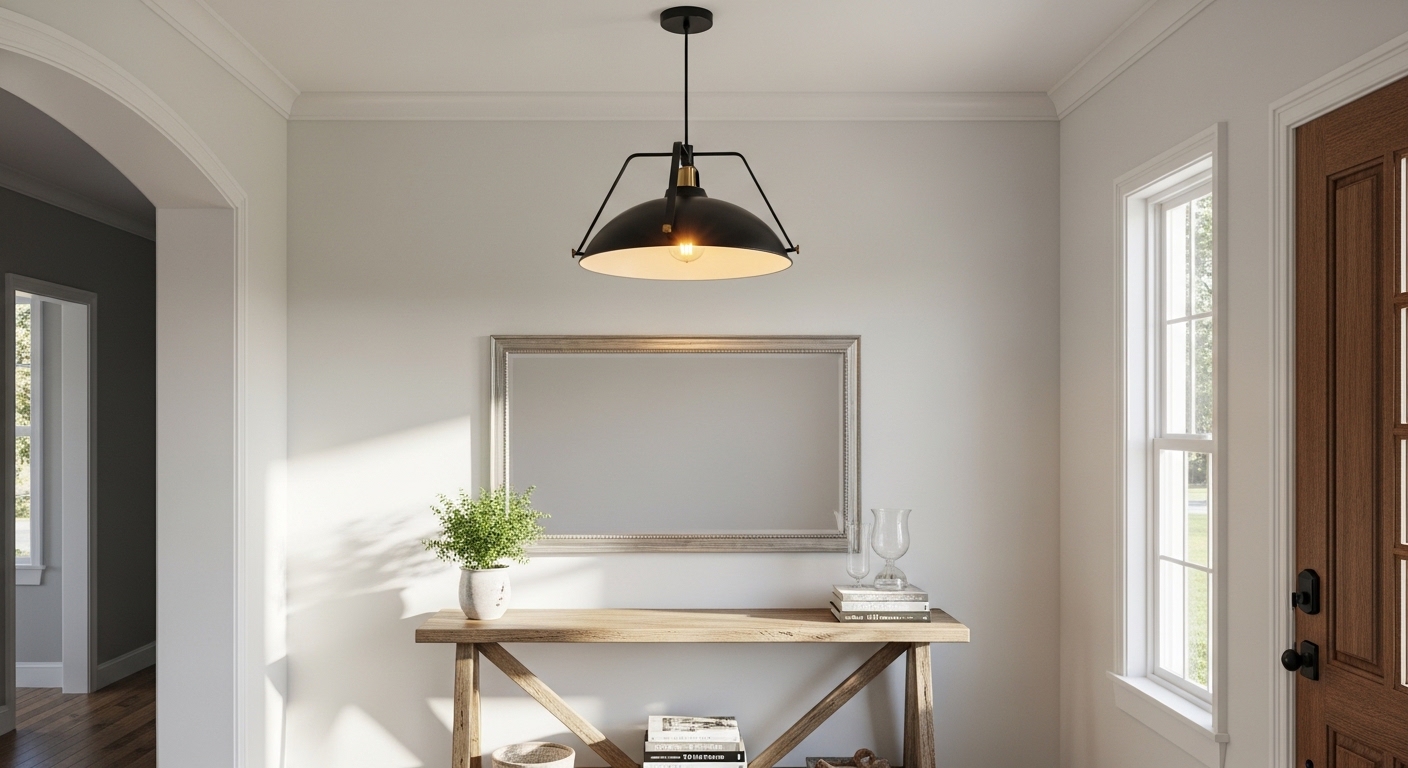
The entryway is the first room anyone sees when they come to your home, including you, every single day when you walk in from the garage or the front door. It sets the tone before a single piece of furniture is registered. Despite this, it's the room I see most poorly lit, usually because it's small and people treat it as a pass-through rather than a room.
Our entry is about 7 feet wide by 5 feet deep with 8-foot ceilings. Small by any measure. When we moved in it had a single flush mount, one of those domed frosted-glass fixtures that looks like it was ordered from a contractor supply catalog and installed as quickly as possible. It worked fine as a light source. It contributed nothing to the entry as a space. I replaced it last October and the difference in how the whole front of the house feels is surprising, given that I changed two fixtures in a 35-square-foot space.
The 1/3 Ceiling Height Rule for Pendant Sizing
Before I started shopping for a new fixture, I looked up the standard sizing guidance and found a rule I've used on every project since: the diameter of a pendant light in an entryway should be roughly one-third of the ceiling height in inches. For an 8-foot ceiling (96 inches), that works out to about 32 inches, clearly too large for my narrow entry. The rule has a useful caveat for smaller spaces: in entries under 8 feet wide, scale down from the formula by 15 to 20 percent to avoid the fixture feeling like it fills the whole ceiling.
My adjusted target: 26 to 28 inches in diameter, or a smaller pendant hung lower to create the same visual weight. I ended up going smaller, a 14-inch pendant hung at a lower height, because our entry is so narrow that a 26-inch fixture would have been overwhelming. The visual weight comes from hanging height, not just fixture size.
Hanging Height: The 12-Inch Rule
The standard guidance for pendant height in an entryway is to hang the bottom of the fixture at least 7 feet from the floor. This ensures clearance for the tallest person who might walk through. My husband is 6'2", and I've been paranoid about this since watching him duck under a too-low pendant at a restaurant. The 7-foot minimum gives him comfortable clearance.
But the guidance I follow for visual proportion is the 12-inch rule: the bottom of the pendant should hang approximately 12 inches above head height of the tallest resident. For us that's 6'2" (74 inches) plus 12 inches = 86 inches from the floor to the bottom of the fixture. Our 8-foot (96-inch) ceiling meant the pendant would occupy the top 10 inches of ceiling height, which felt right, present without looming.
I measured and marked this height with painter's tape before ordering. Then I sat with the tape mark for a day and adjusted down 2 inches. I found the original mark felt too high in our low space and I wanted the pendant to feel anchored to the entry rather than floating at the ceiling. Final mounting height: 84 inches to the bottom of the fixture. The pendant with its cord runs from the ceiling box at 96 inches to the fixture at 84 inches, a 12-inch drop. Tight for a dramatic pendant, but correct for a petite space.
Mini Pendant vs Flush Mount: My Actual Choice
I spent two weeks going back and forth between a mini pendant and a flush mount for this space. The flush mount decision is the safer one for an 8-foot ceiling. It hugs the ceiling and doesn't read as a dramatic element, which works well if the entry has other interesting elements (a console table, a good mirror, interesting wallpaper). The pendant decision adds vertical interest and gives the entry more of a "moment."
Our entry has plain walls and a simple console from IKEA, so I needed the fixture to provide the drama. I went with a mini pendant, a small brass fixture with a clear glass globe, from the BO-HA entryway lighting collection. The clear glass lets you see the warm Edison-style bulb, which reads as intentional and welcoming rather than purely utilitarian. The brass finish ties to the hardware on our front door (brushed brass, which I installed myself two years ago) and the console's brass-legged base.
The total fixture cost was $87. Electrician cost to rehang: $65 (less than an hour, Tom just relocated the junction box position slightly and rehung, which is much simpler than new wiring). New glass fixture total: $152. Well within my goal of keeping the entry update under $300.
The Second Layer: Console Sconce or Table Lamp
The overhead pendant handles ambient light. What makes an entry feel finished is a second layer at eye level. Either a table lamp on the console or a wall sconce flanking a mirror. This lower layer provides the warmth that overhead light alone can't. It's the difference between an entry that's adequately lit and one that makes you feel welcomed.
I went with a single table lamp on the console rather than flanking sconces because our entry isn't wide enough for sconces on either side without looking crowded. The lamp is a simple ceramic base (thrifted from the Alberta Arts District market for $12, repainted in matte white) with a small linen drum shade. It plugs into an outlet that's on a timer. It turns on at 4:30 p.m. And off at 10 p.m. I never think about it; it's just on when we come home in the evening, which is exactly the effect I wanted.
If your entry is wide enough for flanking sconces, roughly 8 feet or wider. That configuration is more visually polished than a table lamp. The symmetry of two wall sconces framing a mirror creates a moment in the entry that reads as deliberate design. In a wider entry I would go that route without hesitation. The mirror reflects the light from both sconces and effectively doubles the glow. It makes the entry feel twice as large and twice as luminous as it actually is.
Bulb Choice: The Temperature Matters More Than You'd Think
I use 2700K bulbs in every fixture in our entry. Color temperature is the spec most people ignore and the one that makes the biggest difference to how a space feels. 2700K is warm white. It has a slight yellow-amber tone that reads as inviting and relaxed. 3000K is cool white, cleaner, slightly clinical, better for task lighting. 4000K is daylight, what you want in a bathroom or a utility room where you need to see clearly.
For an entry, 2700K is the clear choice. You want the entry to feel warm and welcoming, not bright and efficient. The warmth of the light connects to how the home feels. It says "you can exhale now" the moment you walk in. According to guidelines from organizations like the Designing Spaces lighting resource library, 2700K in residential entries is the professional default for exactly this reason.
I also recommend dimmers on the entry fixture. The pendant is on a dimmer switch that replaced the original toggle, a $28 Lutron dimmer that I installed myself in about 20 minutes. During the day it runs at 100%. When we come home in the evening I dim it to 60%, which softens the entry and complements the table lamp warmth. It takes 30 seconds to install a habit that changes how your home feels every evening.
The Full Entry Lighting Setup: What I'd Recommend
Here's the formula distilled to specifics for an 8-foot-ceiling entry:
- Overhead: Mini pendant hung so the bottom is 84 inches from the floor. Diameter 12 to 18 inches for narrow entries, up to 24 inches for wider ones. Brass or matte black finish depending on door hardware. Clear glass or open shade to show the bulb warmth.
- Eye level: Table lamp on console OR flanking wall sconces at 60 inches center height. Warm linen shade. Timer-controlled so it's on when you arrive home.
- Bulb: 2700K warm white in every socket. 800 lumens per fixture is plenty in a small entry.
- Dimmer: Yes, on the overhead. Non-negotiable once you've experienced the difference.
The full system costs between $150 and $400 depending on fixture choices. Our entry update, pendant plus lamp plus dimmer switch plus one hour of electrician time, came in at $267. The impact on how the house feels every time we come home is impossible to overstate relative to that cost.
I go deeper on how layered lighting works throughout the house in my post on wall sconces vs ceiling lights for bedrooms and living rooms. And when you're ready to think about kitchen lighting, the pendant-sizing principles here translate directly, read my post on choosing kitchen island pendants for the full kitchen version. If you're deciding between brass and matte black for your entry fixtures, my post on brass vs matte black lighting walks through exactly how I make that call for each room.
Shop This Post
Quick Answers
Q: What size pendant light do I need for an 8-foot entryway ceiling?
The 1/3 rule gives you a target of about 32 inches in diameter, but for narrow entries (under 8 feet wide), scale down 15 to 20 percent. In an 8-foot ceiling entry that's 7 feet wide, a 14 to 20-inch pendant hung at the right height reads as well-proportioned. Hang the bottom of the fixture 84 inches from the floor minimum, 12 inches above the tallest person's head height.
Q: Should I use a pendant or flush mount in a low-ceiling entry?
For entries with 8-foot ceilings, either works, flush mounts are safer for headroom and work well when the entry has other design elements. Pendants add a design moment and vertical interest if the entry is simple. A mini pendant hung tight to the ceiling (12-inch drop or less) gives you the pendant look without sacrificing headroom.
Q: Do entryways need a second light source besides the overhead?
Yes, a second layer at eye level (a table lamp on a console or wall sconces flanking a mirror) makes an entry feel welcoming rather than simply lit. The overhead handles ambient light; the lower layer handles warmth and atmosphere. Even a single lamp on a timer makes a meaningful difference to how the entry feels when you come home.