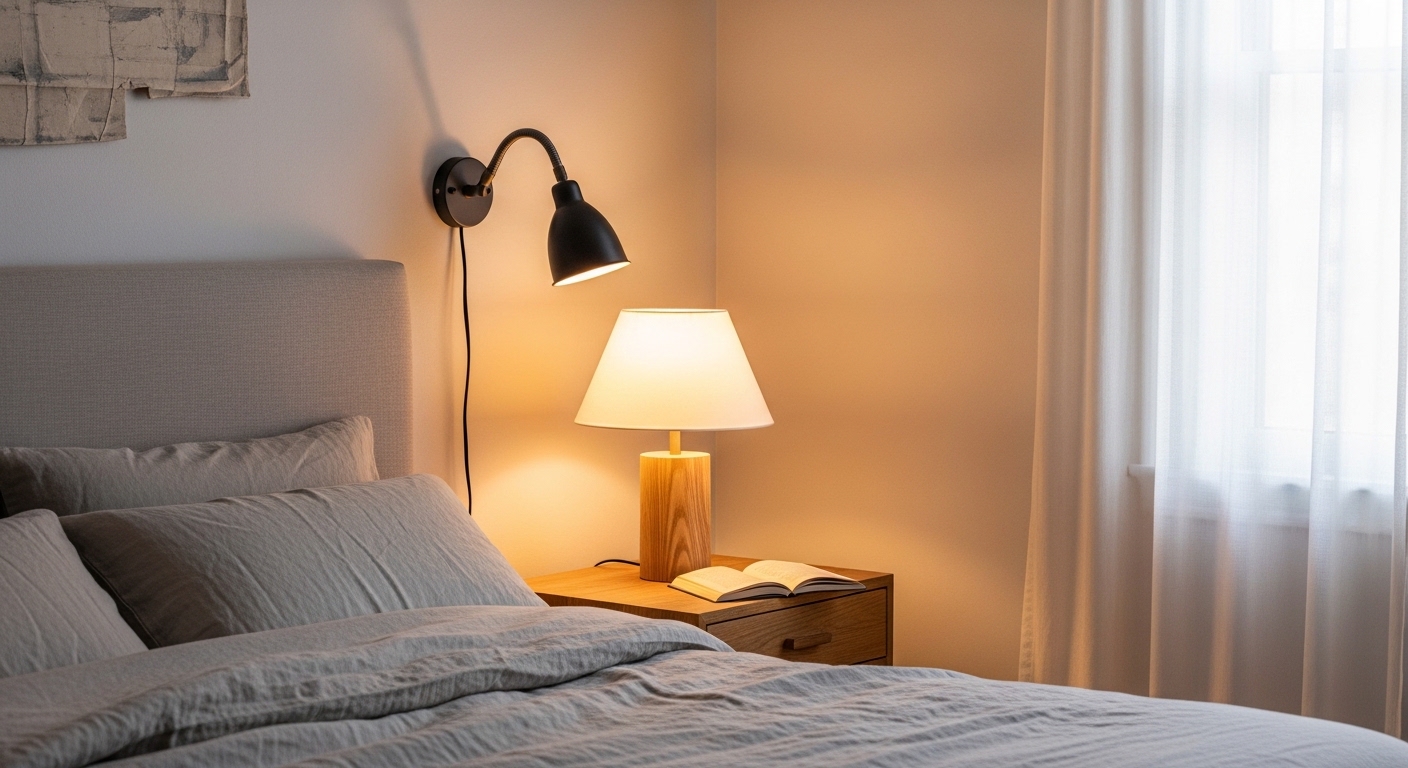
Bedside lamp versus wall sconce, after ten months with sconces: sconces win for most bedrooms, because they free a small nightstand, put the reading light at the right height, and give each side its own switch, and they lose only on flexibility, which matters if you rearrange often or rent and can't patch. I switched from table lamps to plug-in bedroom wall lamps because our nightstands are 18 inches wide and I was knocking the lamp base every time I reached for my phone in the dark; no electrician, cord behind the headboard, an hour for both sides. This post is the ten-month accounting: what changed, what I gave up, the plug-in install step by step, the height and the position, the switch question, the light on the page compared side by side, the nightstand surface and what's on it now, when a lamp wins, the swing-arm middle option, the shared bed and one reader, the rental and the patching, what each costs, mistakes, and the verdict with the exceptions.
What changed
The nightstand surfaces feel spacious for the first time, with room for the things I use: water, the current book, the phone, and a dish for the things from pockets. The reading light is better positioned, at eye level when sitting up, so the light falls onto the page rather than up into my eyes or across the room as the lamp's did from below. Individual switches on each sconce mean neither of us gets up to turn off the other person's light, which had been a nightly negotiation for six years. And the bed looks intentional, two matching fixtures on the wall reading as a headboard, in a way two lamps on two small tables never did. Ten months, and I've stopped noticing the sconces, which is the compliment.
What I gave up
The flexibility to move the lamps. Sconces can't be repositioned without patching the wall; plug-in ones leave two screw holes or an adhesive-strip ghost. I've rearranged the bedroom once in four years, so this trade-off was fine; if you're someone who moves the bed twice a year, it isn't. I also gave up the lamp's presence on the nightstand, which sounds like nothing and which some bedrooms need: a bare nightstand under a sconce can look like a hotel, and a small plant fixed it.
The plug-in install, step by step
Tape at the height, two evenings in bed with a book looking at it. Mark the mounting plate's holes through the tape. Two wall anchors and two screws, or two adhesive strips rated for three times the sconce's weight on a smooth wall, which is what my sister used in her rental. Sconce on the plate. The cord runs straight down behind the headboard to the outlet, in a paintable cord channel where it shows, which was 6 inches on our wall. A plug-in dimmer at the outlet, $12. An hour for both sides, and the only tool was a drill. The placement rules have the tape method in detail.
Height and position
The center of the sconce at 60 inches from the floor for our bed, whose mattress top is 25 inches, so about 20 inches above the pillow: close enough to light a page, high enough not to be in the way when you sit up. Measure from the mattress if yours isn't standard: 18 to 24 inches above the mattress top. Centered over the nightstand, or 24 to 30 inches out from the bed's center line without one, so the light lands on the book side and not the pillow side. Ours are centered on the 18-inch nightstands, 62 inches apart, with 4-inch shades that reach 3 inches inward. Higher than 66 and the sconce lights the ceiling; lower than 54 and it's a lamp on the wall.
The switch
The thing that decides whether bedside light gets used. Our sconces have a rotary switch on the backplate, within reach of the pillow, and a plug-in dimmer at the outlet for the level, which is set once and left. The table lamps had had switches on the socket under the shade, which meant reaching into the heat, and one had a cord switch that lived on the floor. A sconce with the switch at the wall by the door is a lamp you never use; on the fixture, on a cord within reach, or on a dimmer beside the bed at 36 inches, and nothing else.
The light on the page, compared
Table lamp: a 450-lumen bulb at 2700K, shade bottom at 24 inches, light spreading up and out from below the page, with the bulb visible when lying down and a glare across the room. Sconce: the same bulb at 60 inches, light coming down over the shoulder onto the page, bulb hidden by a fabric shade from every angle in the bed. The sconce is the better reading light by a distance, and the difference is where the source is relative to the eye and the book. The verdict is the same as it was at month one; the geometry is why.
The nightstand now
Water, the book, the phone face down, a small dish, a plant on one side and a candle on the other. Nothing that has to be moved to reach anything. The 18-inch nightstand that had been three-quarters lamp is a surface, and the nightstand post is the five things and the order. The lamp itself, a brass one I'd liked, is in the guest room on a wider table, where it has room to be a lamp.
When a lamp wins
A wide nightstand, 24 inches and up, where the lamp base doesn't crowd. A rental with a strict landlord and a textured wall that adhesive won't hold. A bedroom you're still arranging. A headboard that's tall and upholstered and would need the sconce mounted awkwardly above it. And a taste for the lamp as an object, the ceramic base, the linen shade, which a sconce doesn't give you. In those bedrooms, a lamp with a base under 7 inches and a switch on the cord at hand height, and a plug-in dimmer.
The swing-arm middle option
A swing-arm sconce, wall-mounted at 62 to 64 inches with a jointed arm that pulls the shade over the book, is the reader's fixture and the compromise between the two: it moves like a lamp and mounts like a sconce. It's what I'd choose for a bed wider than its nightstands, and what my husband would have chosen if the wall had been his. In our bedroom the fixed sconces won because the wall wanted to be quiet; the guest room has a swing-arm beside the chair for the reason above.
One reads, one sleeps
The sconce's shade directs the light down and slightly outward, so at 30 percent on my side the light doesn't reach my husband's pillow, which the table lamp's had; a lamp throws in every direction. The test: lie on the other side with your eyes closed and see if you can tell the light is on. With the sconces I can't; with the lamps I could, every night. This alone would have decided it, and it's the argument for sconces in any shared bed where the schedules differ.
The rental version, and the patching
Plug-in sconces on adhesive strips rated for four times the weight, at the same height, cord in a channel behind the nightstand, plug-in dimmer; removal is a heat gun on the strips and nothing to patch. With screws, two holes per side, which spackle fills in a minute and which a landlord has never noticed. A rechargeable sconce with no cord at all is the third option, charged every couple of weeks, and it's what the rental version of my sister's bedroom uses.
The bulb, whichever fixture
2700K, CRI 90, 450 lumens, dimmable, E26, frosted or behind a fabric or opal shade so the filament never shows from the pillow. 600 lumens on the side of whoever reads small print, rather than mounting that fixture lower. Warm-dimming bulbs, which go amber as they dim, are the nicest thing to happen to bedside light and cost $4 more; both sides have them. And nothing over 3000K beside a bed, which is the bulb that came in the table lamps from the store and is why the first month with them was worse than it needed to be.
Sconces and the rest of the bedroom's light
The sconces are the task layer, and they work best with two others: the ceiling light on a dimmer and rarely on, and a small lamp on the dresser on a timer that's the light we come up to. Three sources, three heights, three switches, and the sconces are the ones you touch; the sconces versus ceiling lights post is the whole bedroom's argument. A bedroom with sconces and a bright ceiling light on the same switch is a bedroom with one mood, and the second switch is the $25 that finishes the sconces.
What each costs
A pair of good table lamps, $120 to $300, plus $24 in plug-in dimmers. A pair of plug-in sconces, $100 to $200, plus the dimmers and a cord channel, so about $150 to $250 all in. A pair of hardwired sconces, the same fixtures plus $200 to $300 of electrician for boxes and a wall dimmer. A pair of rechargeables, $80 to $200 and nothing else. Ours were plug-ins at $118 the pair plus $30 of dimmers and channel, and the lamps they replaced had cost $160 and are working elsewhere.
Style, and matching the room
Fabric or opal shades, cylinders or small drums, in the metal the room already has, which in our bedroom is black to match the curtain rod and the frames; brass in a warmer room. A sconce should be quieter than the headboard, under 10 inches tall, and matched exactly to its pair, because two sconces that differ by a shade are the first thing anyone sees. The plug-in ones look identical to hardwired ones from the doorway; the cord is behind the nightstand and the plate is the same.
In one paragraph
Sconces at 60 inches over the nightstands with the switch on the fixture and a dimmer at the plug, 2700K behind a shade, plug-in if the wall's closed and rechargeable if the outlet's wrong; lamps only for wide nightstands and rooms still moving; swing-arms for the reader. An hour for both sides, and the nightstand gets its surface back.
Mistakes
Hanging the first sconce at 66 inches, which lit the ceiling; lowered to 60. The cord run down the outside of the nightstand for a week before the channel arrived. A clear bulb in an open shade for one night, a filament in the eye. And six years of lamps on 18-inch nightstands, knocking the base every night, which is the mistake this whole post is about and which cost $148 to fix.
The ten-month scorecard
Nights I knocked a lamp base reaching for the phone: zero, from about three a week. Times one of us got up to turn off the other's light: zero, from nightly. Books finished in bed: more, which I attribute to the light on the page and my husband attributes to the sconces being on his side of the argument. Wall holes: four. Regrets: none, and the one thing I'd change is the week I waited for the cord channel.
Verdict, with the exceptions
Wall sconces win for bedside use in most bedrooms: small nightstands, shared beds, readers, and anyone who wants the bed to look decided. Lamps win for wide nightstands, strict rentals, and bedrooms still in flux. Swing-arms win for the serious reader. And in every case, 2700K, 450 lumens, a shade that hides the bulb, and a switch you reach from the pillow, which matters more than which fixture it's on. Ten months, no regrets, and my sister Jen has the lamps.
Shop this post: bedroom wall lamps, plug-in wall sconces and rechargeable wall sconces